

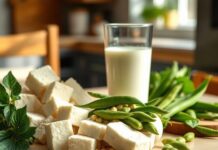



If you are weighing soy foods breast cancer concerns, the clearest takeaway is that ordinary foods such as tofu, tempeh, edamame and soy milk have not been shown to increase breast cancer risk. Among people who have had breast cancer, eating soy foods has been linked with lower recurrence in observational studies, but that does not prove soy prevents cancer or treats it. Concentrated isoflavone supplements are a separate question and are less well studied.
Soy Foods Breast Cancer Research: What It Can Tell You
Soy contains isoflavones, plant compounds that can bind to estrogen receptors. That resemblance to estrogen helps explain why soy has prompted concern, particularly for estrogen-receptor-positive (ER-positive) breast cancer. But binding in a laboratory does not mean soy foods act like human estrogen in the body. A 2025 review by Mark Messina and Sarah Nechuta reports that clinical research has not found soy foods or isolated isoflavones to affect markers such as breast-cell proliferation or mammographic density. These markers are not the same as long-term cancer outcomes, but they help put the estrogen concern in context.
Much of the concern about stimulating existing estrogen-sensitive tumors comes from cell and animal research. Human findings do not establish the same effect. In observational studies, soy food intake has not been linked to worse outcomes for people with ER-positive disease, including those taking tamoxifen. This is reassuring, but it cannot prove that every soy product, dose or supplement is safe in every treatment situation.
Before A Diagnosis: Risk And Whole Soy Foods
Population studies generally associate higher soy food intake with lower breast cancer risk, but they cannot establish that soy caused the difference. Diets and other lifestyle factors vary, and researchers cannot fully separate their effects. Some of the research comes from populations in China and other parts of East Asia, where soy has traditionally been eaten more often and in different amounts than in many Western countries. Those results do not tell you that adding soy to a lower-soy diet will produce the same effect.
Isoflavone intake from food also varies with the product and how it is made. A serving of tofu is not a standardized dose, and results from traditional dietary patterns should not be treated as proof that soy prevents breast cancer. If you enjoy soy foods, the research gives no clear reason to avoid them for fear of increasing risk.
After Diagnosis: Recurrence Findings And Their Limits
The Shanghai Breast Cancer Survival Study, led by Xiao Ou Shu and colleagues, followed 5,042 women with breast cancer in China. Researchers assessed soy food intake after diagnosis and tracked recurrence and deaths. Over a median 3.9 years, higher soy intake was associated with lower recurrence and mortality; the association appeared in women with ER-positive and ER-negative disease, and in tamoxifen users and nonusers. Because this was an observational cohort, it cannot show that soy itself caused the better outcomes.
A 2023 systematic review and meta-analysis by M. Diana van Die and colleagues combined 32 observational studies of plant compounds and breast cancer outcomes. Its pooled results linked soy isoflavones with a 26% lower risk of recurrence. The authors also noted an important gap: studies cannot establish whether starting or substantially increasing soy after diagnosis has the same association as having eaten it beforehand. No long-term randomized trial has tested whether soy foods prevent recurrence.
Together, these findings are reassuring about eating soy after diagnosis, including with ER-positive disease. They do not make soy a treatment or a substitute for prescribed care. If you are in treatment, ask your oncology team about supplements or major diet changes rather than changing medication or treatment on your own.
Why Supplements Are Not The Same As Soy Foods
Isoflavone pills and extracts can deliver concentrated amounts that are not equivalent to eating tofu or drinking soy milk. The 2025 review describes moderate soy food intake as acceptable for people with breast cancer, while noting that few population studies included intakes above about two traditional Asian servings a day, or roughly 50 mg of isoflavones. That is a limit in what has been studied, not evidence that higher food intake is harmful. High-dose supplements have even less outcome evidence, so food findings should not be used to assume they are safe or beneficial.
Regional guidance can differ, but the Cancer Council Australia says breast cancer survivors do not need to avoid soy foods. If you have breast cancer and are considering an isoflavone supplement, discuss the product and dose with your oncologist or a registered dietitian familiar with cancer care. For most readers, the evidence supports treating soy foods as foods—not as a cancer risk to fear or a remedy to rely on.