

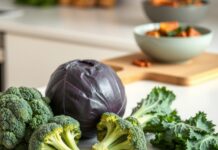

















For most people, goitrogen foods such as broccoli, cabbage, and kale are not a reason to avoid vegetables or worry about thyroid damage. These foods contain compounds that can interfere with thyroid hormone production under some conditions, but ordinary servings are different from unusually large amounts eaten raw. Iodine intake also matters.
How Goitrogen Foods Could Affect Thyroid Function
Cruciferous vegetables belong to the Brassica family. They contain glucosinolates, which can break down into compounds such as thiocyanate and goitrin. These compounds may interfere with the thyroid’s use of iodine or its production of hormones. That is the basis for calling them “goitrogenic.” It describes a potential effect, not proof that a normal portion harms your thyroid.
A comprehensive systematic review, Do Brassica Vegetables Affect Thyroid Function?, examined 123 articles covering laboratory, animal, and human research. The researchers were affiliated with Jagiellonian University Medical College in Kraków, Poland. They assessed outcomes including thyroid hormone levels and iodine uptake. Most of the results, they concluded, cast doubt on claims that Brassica vegetables have harmful antithyroid effects in humans, particularly when iodine intake is adequate.
Because those 123 articles included different kinds of research, the review is not the same as a large clinical trial showing that every amount is harmless for every person. It does, however, help put the concern in perspective: the overall findings do not support avoiding normal portions as a general thyroid-protection strategy.
Why Iodine And Amount Matter
Your thyroid needs iodine to make hormones. If your iodine intake is low, compounds that interfere with iodine use may be more relevant than they are for someone with adequate intake. Iodine availability differs around the world, in part because salt iodization policies and local iodine sources vary. So a finding from one population may not apply equally to people elsewhere.
Very large amounts eaten raw are a separate question from a usual serving alongside other foods. The concern is most plausible with an unusually high, repeated intake, especially if iodine intake is low. Research does not establish a single amount at which these vegetables become unsafe for everyone, so a precise cutoff would be misleading.
More iodine is not automatically better: chronic excess from sources such as salt or drinking water has also been associated with thyroid problems. Don’t start iodine supplements to “balance out” vegetables without advice from a clinician.
Does Cooking Make A Difference?
Heat and food preparation can reduce the goitrogenic activity of cruciferous vegetables, although the effect varies with the vegetable and cooking method. Cooking is a sensible option if you regularly eat large quantities, but you do not need to cook every serving to make these foods acceptable. The research does not show that cooking is necessary for ordinary portions.
In practical terms, you can include broccoli, cabbage, kale, cauliflower, and Brussels sprouts in a varied diet. If your usual routine involves exceptionally large quantities of raw Brassica vegetables, consider varying your choices and eating some cooked. That is a measured precaution, not a claim that a particular raw serving will damage your thyroid.
Do You Need To Avoid Them If You Have Hypothyroidism?
Having hypothyroidism does not, by itself, mean you need to cut out broccoli, cabbage, or kale. The review’s overall conclusion supports including these vegetables in a daily diet when iodine intake is adequate. It does not establish that every person with thyroid disease has the same iodine status or dietary needs, so personal circumstances still matter.
If you have a diagnosed thyroid condition, keep following your treatment plan rather than trying to manage it by removing individual vegetables. For a plain-language overview of the conditions, see hypothyroidism and hyperthyroidism. If you are concerned about iodine deficiency, take iodine supplements, or eat unusually large amounts of raw cruciferous vegetables, ask your clinician whether your overall diet or care plan needs attention.
Bottom line: Ordinary servings of broccoli, cabbage, and kale are not generally considered a thyroid threat. Iodine status and exceptionally high raw intake can change the context; cooking may reduce goitrogenic activity, but routine avoidance is not supported by the overall human findings.