





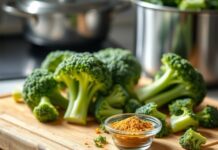









If you’re wondering how to cook broccoli while keeping sulforaphane formation in mind, chopping it before cooking is a reasonable step—but the case for letting it rest is less certain. Cutting disrupts plant cells, bringing the enzyme myrosinase into contact with glucoraphanin, a compound that can be converted into sulforaphane. Research supports that mechanism, but it does not establish a particular resting time as a proven kitchen rule.
How To Cook Broccoli With Myrosinase In Mind
In intact broccoli, glucoraphanin and myrosinase are separated within the plant’s cells. Chopping or chewing disrupts that structure, allowing the enzyme to act on its substrate. Heat complicates matters: cooking can reduce or deactivate myrosinase, and sulforaphane itself can also be lost during processing. So chopping before cooking creates an opportunity for formation, while cooking method and heat exposure influence what remains.
That makes a short pause after cutting plausible: the enzyme has some time to work before heat is applied. But the research described here does not compare specific resting times in a way that establishes how long you should wait, or prove that resting chopped broccoli reliably preserves more sulforaphane in a meal.
What Chopping And Resting Studies Actually Tell Us
A study by Ana Mariel Torres-Contreras and colleagues examined broccoli cut into different sizes, including chopped florets, then stored at 20°C (68°F) for up to 24 hours. The researchers measured several bioactive compounds. Total isothiocyanates rose immediately after the most intensive chopping, while sulforaphane was 65% higher after storage in florets—not in the chopped sample highlighted for its immediate change. These findings show that cutting and storage can affect broccoli compounds, but they do not test a brief rest before cooking or establish that chopping and resting preserves sulforaphane in a cooked serving.
Cooking results also vary. In a study reported by USDA Agricultural Research Service researchers Grace Wang and colleagues, four broccoli cultivars were boiled, microwaved or steamed. Steaming for 1–3 minutes increased sulforaphane yield in all but one cultivar. The authors also found that cultivar mattered, so that timing is a result from particular broccoli varieties and test conditions, not a guaranteed optimum for every head or home kitchen.
Laboratory work by Yingjian Lu and colleagues found higher sulforaphane levels in broccoli after mild, controlled heating, with levels changing sharply across temperature ranges. That finding helps explain why heat can affect formation, but it does not translate into a simple microwave setting: the experiment controlled temperature, and ordinary cooking times and appliance conditions vary. If you prefer roasting, steaming or another method for taste and texture, these studies do not show that you must abandon it.
Can Mustard Powder Help After Cooking?
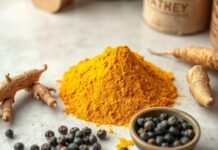
Mustard powder offers another way to bring myrosinase to cooked broccoli. In a randomized crossover study, Olukayode Okunade and colleagues gave 12 healthy adults 200 g (about 7 oz) of cooked broccoli, with or without 1 g (about ¼ teaspoon) of powdered brown mustard. The researchers measured a sulforaphane metabolite in participants’ urine over 24 hours. Its average level was more than four times higher when mustard was added.
This is human evidence that mustard can increase a marker of sulforaphane availability after cooked broccoli, but it is a small study and measured a urinary metabolite—not a health outcome. A separate study in 11 people with ileostomies found that adding mustard seeds to broccoli soup increased sulforaphane recovered in ileal fluid sixfold. That result concerns delivery to the end of the small intestine, not a demonstrated health benefit, and mustard seeds are not the same preparation as powdered brown mustard.
For a practical option, you could stir a little mustard powder into cooked broccoli or a soup once it is off the heat. The human study used 1 g with a 200 g serving; it does not establish a dose that improves health or guarantee the same result for every person or meal. For more preparation ideas, see our guide to preparing broccoli with sulforaphane in mind.
A Useful Takeaway, Not A Health Guarantee
Chopping broccoli before cooking brings myrosinase and glucoraphanin together, and a short rest is mechanistically plausible. But current findings do not establish an ideal rest period or prove that this routine increases sulforaphane in people. Cooking affects the enzyme and the compounds, while mustard powder has shown a measurable effect on sulforaphane-related markers in small human studies.
Use these details as options, not strict rules: chop before cooking if it suits your routine, choose a cooking method you enjoy, and consider mustard powder if you like the flavor. Higher sulforaphane availability is not evidence that broccoli prevents or treats disease.