






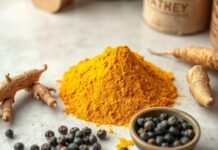













If you’re wondering about black pepper for turmeric absorption, the short answer is that piperine, a compound in black pepper, can increase the amount of curcumin that becomes available in the body. But that does not show that adding pepper to a meal improves your health, or that a concentrated turmeric-and-piperine supplement will treat a condition. Food seasoning and high-strength supplements are different exposures, with different safety questions.
What black pepper for turmeric absorption actually means
Turmeric contains curcuminoids, including curcumin. Curcumin is poorly absorbed and quickly processed by the body, so relatively little may reach the bloodstream after ordinary oral use. Piperine can raise curcumin’s bioavailability—the amount available for the body to use. A commonly reported figure is a large increase, sometimes described as 20-fold, but an increase in blood exposure is a measure of absorption and handling, not a measure of symptom relief or disease prevention.
It also matters what “pepper with turmeric” means. A sprinkle of black pepper in a recipe is not a standardized piperine dose. Supplements may use concentrated piperine alongside concentrated curcuminoids, sometimes with other ingredients intended to improve absorption. You cannot assume results from a supplement apply to a home-cooked meal, or vice versa.
More absorption does not establish more benefit
The National Center for Complementary and Integrative Health (NCCIH) says evidence on turmeric and curcumin is not strong enough to conclude that they are beneficial for health conditions overall. Some research on oral products for knee osteoarthritis has shown promising early results, but higher-quality research is needed, and it remains unclear how enhanced bioavailability affects outcomes. Findings for particular products or conditions do not establish that turmeric and pepper in food deliver the same effect.
In other words, piperine may change how much curcumin reaches the body, but there is no established conversion from “more absorbed” to “more effective.” If you use turmeric in cooking, enjoy it for its flavor; there is no need to add black pepper as a proven treatment strategy.
Why supplements call for more caution
Culinary use is not the same as taking a concentrated extract. The U.S. Pharmacopeia’s Dietary Supplement Admission Evaluation and Labeling Expert Committee, which assessed safety in October 2025, reported no identified safety concern for turmeric used as a spice or in typical food amounts. Supplements can contain much higher amounts of curcuminoids and may be formulated to increase absorption. The committee’s 2026 review concluded that liver problems have been reported very rarely with turmeric- or curcuminoid-containing supplements. Some cases have been serious, including rare acute liver failure.
Reported liver injury often appears after one to four months of use, according to the review, and typically improves after the supplement is stopped. Researchers cannot say from these reports that piperine alone causes the injury: products and amounts vary, and some cases involved other medicines or supplements. A case report from an Australian hospital described one person who developed severe liver injury after five months of daily homemade turmeric-and-black-pepper drinks, but a single case cannot estimate how often this happens or prove which ingredient was responsible.
Stop using a turmeric or curcumin supplement and seek medical advice if you develop symptoms such as unusual fatigue, poor appetite, nausea, dark urine, or yellowing of the skin or eyes. If you have a history of liver problems, discuss a supplement with a health professional before taking it.
What about turmeric interaction with drugs?
Piperine and curcumin have been proposed to affect enzymes involved in processing medicines. In a small randomized crossover study, Laurie Volak and colleagues gave eight healthy volunteers a curcuminoid-and-piperine preparation or placebo and measured three test medicines: midazolam, flurbiprofen, and paracetamol (acetaminophen). Short-term use of the preparation did not meaningfully change the medicines’ levels or processing in that study.
That is somewhat reassuring for those three medicines under those specific study conditions, but it cannot rule out interactions with other medicines, different doses, or long-term use. If you take prescription or over-the-counter medicines, ask a pharmacist or clinician before starting a concentrated turmeric, curcumin, or piperine supplement. Bring the product label, since the amount and formulation matter. The same caution is sensible if you take several supplements or have liver disease.
The useful distinction is simple: piperine can increase curcumin exposure, but this has not been shown to make turmeric reliably more beneficial. Season food to taste; treat absorption-enhanced supplements as a separate product, and check their risks and potential interactions before using them.