











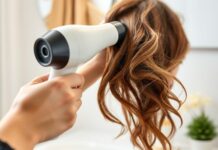







If you’re asking “does blow drying damage hair,” the answer depends partly on how you use the dryer. Air-drying avoids direct heat, but laboratory testing found that a dryer held well away and kept moving caused less measured surface damage than natural drying. The result is useful, not a universal rule: it comes from one controlled experiment on hair tresses, not a comparison of everyday routines across different hair types.
Does blow drying damage hair? What the lab test found
In a 2011 study published in Annals of Dermatology, Yoonhee Lee and colleagues repeatedly shampooed and dried chemically untreated hair tresses, then examined their structure, moisture and color. The tresses were treated 30 times. The researchers compared room-temperature drying with three dryer setups: 15 cm (about 6 inches) away at 47°C (117°F), 10 cm (about 4 inches) away at 61°C (142°F), and 5 cm (about 2 inches) away at 95°C (203°F). They used continuous airflow and movement in the dryer condition described as less damaging.
As the temperature increased, the hair surface tended to show more damage. The authors concluded that the dryer setting at 15 cm, with continuous motion, caused less surface damage than natural drying. That does not mean every dryer or technique is gentler than air-drying. It means that, under those specific laboratory conditions, distance and movement mattered: the more moderate setup performed differently from close, hotter exposure.
Why air-drying is not automatically damage-free
The comparison may sound surprising because air-drying involves no heated airflow. But the experiment detected damage to the cell membrane complex—a structure within the hair shaft—in the naturally dried tresses, and not in the dryer-treated groups. The researchers suggested that extended contact with water might help explain this result. It does not establish that air-drying causes breakage in daily life, or that keeping hair wet for a particular length of time is harmful for everyone.
Other results also call for care in interpreting the comparison. No damage to the hair cortex was detected in any group, and differences in moisture content between the treated groups were not statistically significant. Hair color changed after 10 treatments in the room-temperature and hottest-dryer groups. These were measurements of treated tresses—not a count of how much hair people lost or how often their hair broke.
What the study cannot tell you
The experiment used standardized, chemically untreated hair rather than people with varied routines, hair textures or histories of coloring and bleaching. It cannot establish which method is best for every person, or how results change with different dryers, airflow settings, climates or styling habits. The researchers’ tested temperatures were measured close to the hair sample, so your dryer’s setting label may not correspond to those exact temperatures at your hair.
The study also did not test whether a specific drying routine prevents breakage. That matters if your hair is already fragile: the findings can guide a gentler technique, but they cannot predict an individual outcome. If you’re considering heat protectant, read more about what heat protectants may do; this drying experiment did not test those products.
A gentler way to dry your hair
- Blot instead of rubbing. Wet hair is more vulnerable to friction, and the study’s background identifies towel drying as one possible source of surface damage. Squeeze or press out water gently rather than scrubbing with a towel.
- If you use a dryer, create distance. The least-damaging dryer setup in this experiment was 15 cm (about 6 inches) away. Keep the airflow moving rather than directing it at one section for a prolonged stretch.
- Choose a moderate setting. The hotter, closer setups produced more surface damage in the test. A lower or moderate heat setting is a reasonable way to avoid replicating that close, high-temperature exposure, although the study did not test every dryer setting.
- Combine methods if that suits you. You can gently remove excess water, let hair air-dry for a while, then finish with a dryer held back and moving. This is a practical option, not a routine proven superior in a trial of people.
For curly hair, the study does not identify a best technique or test diffusers. You can still apply its central finding—avoid holding hot airflow close to one spot—while choosing a drying method that works for your texture and styling needs.
Overall, neither method is guaranteed to prevent damage. The lab findings favor a dryer used at a distance with continuous motion over the tested natural-drying condition, while also showing that close, high heat can be rougher on the hair surface. Gentle handling and avoiding concentrated heat are sensible ways to reduce avoidable stress on the shaft.
If you’re concerned about persistent breakage or changes in your hair or scalp, a clinician or dermatologist can help assess what may be contributing.