











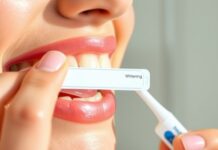






If you’re wondering how to use whitening strips, start with the product label: use the strips for the stated time and schedule, and don’t extend either to chase faster results. Peroxide strips can whiten teeth, but temporary tooth sensitivity and gum irritation are common side effects. Healthy teeth and gums matter before you begin.
What Concentration And Contact Time Can Tell You
Hydrogen peroxide and carbamide peroxide are used in tooth whitening. A product’s concentration and the time it stays on your teeth both affect how much peroxide exposure you get. It’s reasonable to avoid increasing either on your own, but the research described here does not establish a single concentration or wear time that works best for every strip, brand, or person.
A 2015 systematic review by Carla Regina Serraglio and colleagues compared over-the-counter strips with trays containing 10% carbamide peroxide. The researchers included eight randomized trials in adults, selected from searches covering studies up to October 2014. Whitening and tooth or gum sensitivity were broadly similar between methods; irritation was higher with the tray gel. The authors rated the evidence very low in quality, so these results don’t prove that all strips and tray treatments perform alike. The review did not identify study locations in the information reported.
For your own routine, use the exact wear time and frequency on your product’s instructions. Don’t wear strips overnight, repeat a session, or use multiple whitening products at once unless the directions specifically allow it. If the label is missing, unclear, or doesn’t identify the active ingredient and its concentration, ask a dentist or pharmacist before using the product.
How To Use Whitening Strips And Limit Gum Irritation
- Read the package first. Directions differ between products, so don’t assume one brand’s schedule applies to another.
- Place the strip on the teeth, not the gums. Follow the product’s placement instructions and avoid folding excess strip material onto gum tissue.
- Keep to the stated contact time. Remove the strip when the instructions say to, and don’t compensate for a missed session with a longer one.
- Stop if the strip slips or irritates your gums. Remove it rather than leaving peroxide in contact with sore tissue.
Gum irritation is among the reported side effects of over-the-counter bleaching products. A scoping review of these products also identified tooth sensitivity as a main adverse effect. Those findings don’t predict whether you personally will have symptoms, but they support taking irritation seriously rather than pushing through it.
Don’t Whiten Over Untreated Cavities Or Gum Disease
Whitening strips are a cosmetic product, not a treatment for tooth decay or gum disease. A clinical study of a different over-the-counter whitening system excluded participants with caries, gingivitis, or periodontitis. That exclusion does not by itself prove what would happen with every strip, but it means the study’s reassuring results don’t apply to people with those untreated problems. Get a dental check-up first if you have a known cavity, sore or bleeding gums, or another unresolved dental concern.
Pause your course if you develop significant tooth sensitivity or gum irritation. If symptoms are severe, persist after stopping, or keep returning when you try again, consult a dentist before restarting. A dentist can check whether another dental problem is contributing; whitening studies cannot diagnose the cause of your symptoms.
Whitening-Strip Rules Differ By Region
Where you live affects which peroxide strengths can be sold directly to consumers. In the UK and EU, products containing or releasing up to 0.1% hydrogen peroxide can generally be sold freely. Products above 0.1% and up to 6% are restricted to dental-professional use, with the first use by a dental professional or under direct supervision; they are not for people under 18. National implementation and product details can matter, so check local rules.
Australia also restricts stronger whitening products, with products above 6% hydrogen peroxide generally reserved for dental professionals. In the United States, the regulatory approach is not the same as the UK/EU consumer-percentage limits; check the product’s labeling and buy from a reputable retailer. Rules and product classifications can change, and an online product sold abroad may not meet the rules where you live. Don’t treat a percentage as a universal measure of safety: the active ingredient, instructions, and local regulation all matter.