











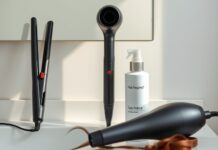








Heat protectants may reduce some hair-shaft damage, but they cannot make frequent high-temperature styling harmless. Lab tests suggest that certain protective polymers can limit damage and breakage, while other experiments show that wet hair can be more structurally vulnerable during hot ironing. If you’re concerned about heat damaged hair, the most dependable approach is to lower heat exposure and use a protectant as one layer of care—not as permission to turn the temperature up.
How Heat Damaged Hair Evidence Shows Risk
Hair is a fiber, and repeated heat can alter its outer cuticle and the keratin proteins inside it. A rougher, weakened surface can make strands more prone to friction and snapping during combing. Breakage happens along the hair shaft; it is different from hair shedding from the scalp.
In a 2011 laboratory study, Yoonhee Lee and colleagues repeatedly dried hair tresses 30 times using different settings and distances. At 15 centimetres (about 6 inches), the dryer produced a measured temperature of 47°C (117°F); closer, hotter settings reached 61°C (142°F) and 95°C (203°F). Surface damage tended to increase with temperature. The researchers also found that drying at 15 centimetres with continuous movement caused less damage in their test than drying at room temperature. That result applies to this particular setup; it does not mean blow-drying is always gentler than air-drying. The study did not find cortex damage, and it did not establish a universally safe dryer setting.
Flat irons and curling irons bring direct contact with much higher heat. In a 2011 experiment, Y. Zhou and colleagues studied hair exposed to flat ironing above 200°C (392°F). Repeated thermal stress increased breakage during combing. The researchers found less damage with selected polymer pretreatments. This supports the idea that some ingredients can help protect hair, but the test does not show that every product labelled “heat protectant” works equally well, or that any product prevents damage altogether.
Why Damp Hair Needs Extra Care
Paul Christian and colleagues tested hair treated with a straightening iron after applying either a water-based, “wet” spray or an ethanol-based, “dry” spray. Both reduced one measure of chemical damage compared with no spray, and the researchers found no difference between the sprays on that measure. But microscopy and tensile testing showed more structural damage when hair was wet or treated with the water-based spray. The authors suggested that rapid water evaporation contributed to the effect.
This was a controlled hair-tress experiment, not a comparison of every product or styling routine. Still, it gives you a sensible reason to let hair dry fully before using a flat iron or curling iron. A spray’s “heat protection” label does not necessarily mean it should be used on damp hair before a hot tool; follow its directions.
What Protectants Can—and Can’t—Do
Product performance depends on the formula. Zhou’s study supports protection from specific polymers under laboratory conditions, including reduced breakage during combing. It does not establish a standard level of protection across brands, or prove that protectants preserve hair through unlimited styling. Think of a suitable product as a possible way to reduce risk, not a guarantee.
Human observations also point to a more complicated picture. In a 2020 clinic-based comparison in Mumbai, India, Ram H. Malkani and colleagues assessed 94 women, comparing those who reported recent heat or chemical styling with women who did not. The styled group had more microscopic hair changes, but the groups did not differ significantly in measured hair breakage index or hair density. Because this was a small, cross-sectional study of clinic patients, it cannot show that heat alone caused the changes or predict what will happen to every person’s hair.
How To Reduce The Risk Of Heat Damaged Hair
- Use the lowest effective setting. Very high heat can damage hair, but these studies do not identify one best temperature for every tool or person. A tool’s displayed setting also does not tell you exactly how hot each strand gets.
- Limit repeated passes and sessions. Repeated exposure was part of the damage seen in laboratory tests. Reducing how often you style, and avoiding multiple passes over the same section, limits that exposure.
- Keep a dryer moving and at a distance. Lee’s experiment supports using a dryer about 15 centimetres (6 inches) away with continuous movement rather than holding it close to one spot.
- Let hair dry before hot ironing. Avoid clamping or curling damp strands, and check whether a product is intended for wet or dry hair.
- Use conditioner and handle fragile hair gently. If your hair is also chemically treated, such as bleached, it may already be vulnerable to breakage; see our guide to limiting further damage to bleached hair.
If you notice persistent or substantial breakage despite changing your styling habits, a dermatologist can help assess it. Heat protectants can be useful, but reducing heat, contact time and repetition remains central to limiting shaft damage.