

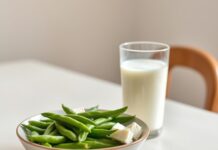









If you’re searching for “soy foods breast cancer,” the short answer is reassuring: people with estrogen-receptor-positive (ER-positive) breast cancer can generally include ordinary soy foods such as tofu, edamame and soy milk in their diet. Studies have not found that these foods increase recurrence, including among people taking tamoxifen. That is different from proving soy prevents cancer or that concentrated isoflavone supplements are safe.
Soy foods breast cancer evidence: What studies found
A large study in Shanghai offers useful context. Xiao Ou Shu and colleagues followed 5,042 women treated for breast cancer, diagnosed between 2002 and 2006. The researchers asked about foods including tofu, soy milk and fresh soybeans, then tracked recurrence and deaths. Over a median follow-up of 3.9 years, higher soy-food intake was associated with lower recurrence and mortality. The association appeared in women with ER-positive and ER-negative cancer, and in tamoxifen users as well as non-users.
This was an observational study: it compared people’s reported diets and outcomes, rather than assigning anyone to eat soy. It therefore cannot establish that soy caused the better outcomes, and the results from women in Shanghai may not translate exactly to every population or diet. Still, it provides direct evidence about whole foods after diagnosis, not just laboratory effects.
A second prospective study, the Life After Cancer Epidemiology (LACE) study, followed 1,954 breast cancer survivors in the United States for about 6.3 years and recorded 282 recurrences. Soy isoflavone intake was assessed roughly 23 months after diagnosis. The researchers found suggestive patterns of lower recurrence among postmenopausal women and tamoxifen users; a subgroup of postmenopausal tamoxifen users with higher daidzein intake had lower recurrence. The subgroup result is not proof that soy improves tamoxifen’s effect, but it does not support the fear that food-level soy cancels it out.
A 2023 systematic review and meta-analysis of observational studies also found that soy isoflavone intake was associated with lower recurrence, including among ER-positive survivors. Because the underlying studies were observational and differed in what they measured and when, the result is an association—not a treatment effect or a dose recommendation. A 2025 review likewise noted that no long-term randomized trial has tested whether starting soy after diagnosis changes recurrence or survival.
Whole soy foods are not isoflavone capsules
Tofu, soybeans, edamame and soy milk deliver isoflavones as part of food. Concentrated isoflavone products, extracts and supplements can provide a different and often more concentrated exposure. The food studies do not establish the safety or benefit of taking these products, and long-term outcome evidence for high-dose supplements is limited. Don’t assume a supplement is interchangeable with a serving of tofu, or use one to try to prevent recurrence without discussing it with your oncology team.
Some reviews describe up to two traditional Asian servings a day—around 50 milligrams of isoflavones—as a reasonable food amount. That figure reflects the intake represented in population studies, not a proven safety ceiling; it does not mean that higher food intake has been shown to be harmful.
What to do if you take tamoxifen
Current observational findings do not show that ordinary soy-food intake interferes with tamoxifen. Guidance has not always been consistent across countries or over time: for example, older Irish patient material cautioned against soy with tamoxifen, while Cancer Council Australia says survivors do not need to avoid soy foods. If advice you’ve received conflicts with what you eat or want to eat, ask your oncologist or oncology dietitian about your specific treatment and any supplement you’re considering. For more on food choices during treatment, see our guide to eating soy during breast cancer treatment.
For most people, the evidence supports keeping familiar soy foods on the menu if they enjoy them. It does not support using soy as a substitute for prescribed treatment or treating supplements as equivalent to food. A clinician can help you assess a concentrated product alongside your medications and care plan.