


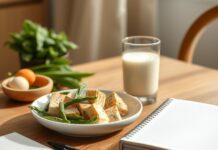
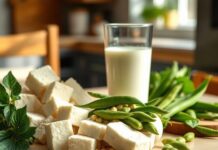








If you’re searching “soy foods breast cancer,” the short answer is reassuring: people with estrogen-receptor-positive breast cancer can generally eat ordinary soy foods, including while taking tamoxifen or an aromatase inhibitor. Tofu, edamame, tempeh and soy milk are not the same as concentrated isoflavone pills, and soy should not be treated as a cancer therapy.
Soy Foods Breast Cancer Patients Can Usually Eat
Soy contains isoflavones, plant compounds that can bind to estrogen receptors. That fact has raised concern that soy might act like estrogen and affect hormone-sensitive cancer. But binding does not mean soy foods have the same effects as the body’s estrogen, and human research has not established that ordinary soy foods interfere with endocrine treatment.
In the Shanghai Breast Cancer Survival Study, Xiao Ou Shu and colleagues followed 5,042 women in China diagnosed between 2002 and 2006. The researchers tracked soy intake after diagnosis alongside recurrence and survival. Over a median of 3.9 years, higher soy-food intake was associated with lower recurrence and mortality. The association appeared in women with both estrogen-receptor-positive and -negative cancer, and in tamoxifen users as well as nonusers.
That is useful reassurance, not proof that soy prevents recurrence. The study was observational: women were not randomly assigned to eat soy or avoid it. Differences in overall diet, health, treatment or other factors could partly explain the results. And its participants lived in Shanghai, where soy foods are commonly eaten; the findings do not establish the effects of every amount or type of soy in every population.
What The Research Says About Tamoxifen And Aromatase Inhibitors
A 2025 review by Mark Messina and Sarah Nechuta summarized clinical and epidemiological research on isoflavones after diagnosis. It found that observational studies do not suggest soy foods undermine tamoxifen or aromatase inhibitors. However, there has been no long-term randomized trial testing whether post-diagnosis soy intake changes recurrence or survival. Evidence about aromatase inhibitors is especially limited, so the findings are reassuring rather than a guarantee that interactions are impossible.
Regional guidance is not completely uniform. Cancer Council Australia says survivors do not need to avoid soy foods, and Dana-Farber Cancer Institute describes moderate amounts—about one to two servings a day—as suitable for people with breast cancer, including those with estrogen-receptor-positive disease. Canadian Cancer Society guidance allows up to three servings daily. A 2017 Irish Cancer Society document advises avoiding soy with tamoxifen. If advice you receive locally conflicts with this, ask your oncology team or a cancer dietitian whether it refers to ordinary food or supplements.
Why Supplements Are A Different Question
Food studies cannot establish the safety of concentrated isoflavone supplements. A pill or extract can deliver a different dose and form of isoflavones than a meal, and long-term evidence on recurrence and survival is lacking. The 2025 review notes that few population studies included people consuming more than about 50 milligrams of isoflavones a day from traditional soy foods. That is a limit in the research—not proof that higher intake is harmful.
For that reason, do not assume a supplement is safe just because tofu or soy milk can fit into a balanced diet. High-dose isoflavone products are not an established way to treat cancer or prevent its return. Check with your oncology team before taking them, particularly during endocrine therapy.
A Practical Way To Think About Soy
If you enjoy soy foods, the research does not give a clear reason to avoid ordinary portions during treatment. There is no universal serving limit supported by evidence; some guidance suggests moderate intake, while recommendations vary by country. Choose foods you like as part of your usual diet, rather than adding soy in the hope of changing treatment outcomes. For a broader overview, read our guide to soy foods and breast cancer.
Your oncology team can help interpret local guidance for your treatment and circumstances. Seek their advice before starting a concentrated supplement or making a major dietary change.