






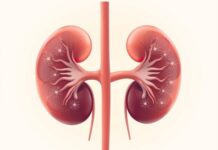














The question behind “too much protein in kidneys” is whether eating more protein causes lasting harm. In adults without chronic kidney disease (CKD), trials show that higher-protein diets can raise estimated kidney filtration, but that change alone does not establish kidney damage. Short-term studies have not found consistent signs of injury; the risk from eating a high-protein diet for many years remains uncertain.
What “Too Much Protein In Kidneys” Means For Filtration
Your kidneys filter waste from your blood. A common estimate of how well they do this is eGFR, or estimated glomerular filtration rate. A higher eGFR after a diet change is not automatically a sign of better health—or of damage. It can reflect a change in how the kidneys are working in response to protein, rather than a lasting change in their condition.
In June 2026, Paulo Ricardo Teixeira Silva and colleagues published a systematic review and meta-analysis of 22 randomized trials in adults without CKD. The trials generally compared diets providing about 25%–35% of calories from protein, or at least 2 grams per kilogram of body weight per day, with normal- or lower-protein diets. The researchers found a higher eGFR on the high-protein diets, but no significant change in serum creatinine across 19 trials involving 1,044 people. They concluded that the eGFR rise may reflect a short-term adjustment and found no consistent biochemical evidence of kidney injury. Because this was a review of trials from different settings, it does not describe one specific population or country.
A Higher Filtration Estimate Is Not The Same As Kidney Damage
One controlled feeding study helps explain the distinction. In the US OmniHeart trial, 164 adults with prehypertension or stage 1 hypertension, but without kidney disease, ate each of three diets for six weeks in 2003–2005. The protein-focused diet replaced some carbohydrate with protein and provided 25% of calories from protein, compared with 15% in the other diets. Researchers at study sites in Boston and Baltimore measured eGFR using cystatin C, as well as other blood markers. The protein diet raised cystatin C-based eGFR by about 4 mL/min/1.73 m². The trial showed a short-term change in filtration—not whether the diet would cause kidney disease over years.
Earlier trial reviews point in a similar direction, though the details differ. Michaela C. Devries and colleagues at the University of Waterloo in Canada and collaborating institutions analyzed 28 studies involving 1,358 healthy adults. Their 2018 meta-analysis found a small increase in GFR when comparing measurements taken after higher- versus lower-protein diets, but no difference in the change from before to after the diets. Taken together, these findings support treating a modest filtration increase as a response to protein intake, not as proof of injury.
What Studies Can—and Can’t—Say About Long-Term Risk
Randomized trials are useful for comparing diets, but many have lasted only weeks or months. A 2018 review of 26 studies found that most lasted less than six months, with only two longer-term cohort studies; the authors also judged all included studies to have moderate-to-high risk of bias. The newer 2026 meta-analysis likewise concluded that long-term kidney effects remain uncertain because most trials were relatively short and often relied on creatinine-based estimates.
That means current trials cannot rule out harm from very high intake sustained over many years, nor do they show that such harm will occur in healthy adults. A reference intake can help put “high” in context: the US recommended dietary allowance is 0.8 g/kg of body weight per day (about 56 g for a 70 kg/154 lb adult). WHO and European reference values cited in a 2018 review are close, at about 0.83 g/kg. These are population reference amounts, not a personal target or a proven upper safety limit.
If you use protein shakes, include their protein in your daily total; the studies assess overall dietary intake, not a guarantee that any particular powder or product is safe. The same uncertainty applies to long-term intake from food: short-term results cannot settle every question about amount, protein source, or an individual’s health.
Why Kidney Disease Changes The Advice
Findings in adults without CKD do not establish safety for people whose kidneys are already impaired. A 2020 review by Gang-Jee Ko, Connie M. Rhee, Kamyar Kalantar-Zadeh, and Shivam Joshi discusses how higher protein intake may worsen existing kidney dysfunction. People with CKD may need a protein plan tailored to their kidney function and nutritional needs; avoid changing intake based on advice intended for healthy adults. If you have CKD or have been told your kidney tests are abnormal, ask a clinician or renal dietitian what intake is appropriate. You can read more about how protein intake differs with kidney disease.