

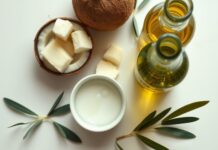



















Coconut oil cholesterol effects depend partly on what you compare it with. It tends to raise LDL less than butter, but trials have not shown it to be better than oils rich in unsaturated fats. For your day-to-day choices, replacing butter or coconut oil with an unsaturated oil matters more than adding coconut oil while leaving the rest of your diet unchanged.
What Trials Say About Coconut Oil Cholesterol Effects
A randomized trial published in 2018 tested extra-virgin coconut oil, extra-virgin olive oil and butter in 91 adults who completed follow-up. The trial took place in Cambridgeshire, UK, during 2017. Participants were healthy volunteers aged 50 to 75; almost all were European Caucasian. For four weeks, they were asked to consume 50 g (about 1.8 oz) of one assigned fat each day, either in their usual diet or as a supplement.
LDL rose more with butter than with coconut oil: the difference between those groups was 0.42 mmol/L (about 16 mg/dL). But coconut oil and olive oil did not differ significantly in their effect on LDL. Coconut oil raised HDL more than either comparison fat, but an increase in HDL does not prove that a food prevents heart attacks or strokes. The trial measured cholesterol and other risk markers, not cardiovascular events. Its short duration and small, relatively specific group also limit what it can tell you about long-term effects or other populations.
A 2018 network meta-analysis by Lukas Schwingshackl and colleagues compared blood-lipid results from 54 randomized trials of oils and solid fats. In its isocaloric comparisons—where one fat replaced another—oils such as sunflower, rapeseed (called canola in North America), safflower and olive oil lowered LDL more than butter. Coconut oil also performed better than butter in the analysis, but it was not shown to beat unsaturated oils. The authors said the results supported replacing foods high in saturated fat with unsaturated oils.
Why The Swap Matters More Than Adding Coconut Oil
A food’s effect depends on the food it displaces. Replacing butter with an unsaturated oil changes the balance of fats in your diet. Adding coconut oil without reducing another fat does not make that same swap; it simply adds another source of energy. The trials that compare oils are most useful for understanding substitutions, not for showing that coconut oil has a special benefit when added to an unchanged diet.
Coconut oil is high in saturated fat. That it raises LDL less than butter in some comparisons does not make it equivalent to olive, sunflower or rapeseed oil. Nor does a change in a cholesterol test establish what happens to heart-attack or stroke risk. A 2023 review by Lukas Schwingshackl and Sabrina Schlesinger noted that randomized trials and prospective cohort studies had not tested coconut oil’s effect on cardiovascular events. That leaves a meaningful gap: blood-lipid results can inform food choices, but they are not direct proof of event prevention or harm.
Does Virgin Coconut Oil Or MCT Oil Change The Picture?
Virgin coconut oil is less processed and can contain more plant compounds than refined oil. But those compounds have not been shown in the cited trials to give virgin oil an LDL advantage over unsaturated oils. In the Cambridgeshire trial, the coconut oil was extra virgin: it compared favorably with butter on LDL, but not with olive oil. The label “virgin” therefore does not change the main comparison.
MCT oil is not the same product as coconut oil. Coconut oil contains several fatty acids, with lauric acid making up the largest share; MCT oil is a separate product. The 2018 network meta-analysis excluded trials of MCT oils, so its results cannot tell you how MCT oil affects LDL. The studies described above also do not establish whether MCT oil changes heart-attack or stroke risk. Avoid transferring coconut-oil findings to MCT oil—or assuming that “medium-chain” means heart-protective.
Traditional diets that include coconut flesh or coconut cream are not the same as a trial of isolated coconut oil. Those diets involve different foods and broader eating patterns, so their health outcomes cannot settle what coconut oil alone does.
If you are choosing a cooking fat for LDL, the evidence favors thinking in terms of replacement: use an oil rich in unsaturated fats in place of butter or coconut oil when it suits the dish. For a broader comparison of cooking fats, see how coconut oil compares with butter and olive oil. If you have high cholesterol or are changing a treatment plan, discuss your options with a clinician.