

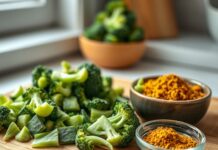
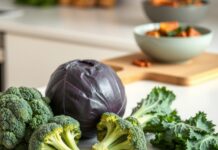

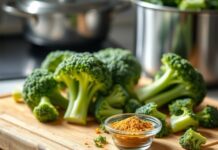






If you’re wondering how to cook broccoli while keeping more sulforaphane available, focus on the enzyme myrosinase. Chopping fresh broccoli brings this enzyme into contact with glucoraphanin, the compound it helps convert into sulforaphane. Heat can disable myrosinase, so cutting broccoli before cooking—and adding an active enzyme source after cooking—may help preserve that conversion pathway.
The basics of how to cook broccoli for sulforaphane
In intact broccoli, glucoraphanin and myrosinase are largely separated within the plant’s cells. Cutting or crushing the florets disrupts those cells, allowing the enzyme to act on glucoraphanin. Cooking then changes the equation: heat can inactivate myrosinase, limiting conversion in the broccoli itself.
For fresh broccoli, a reasonable approach is to chop it before cooking and let it stand while you prepare the rest of the meal. That gives the enzyme an opportunity to act before heat is applied. The mechanism makes sense, but the research summarized here does not establish a single best resting time or show that every cooking method produces the same result. If you prefer roasting, steaming or another method, you can still use the chop-and-rest step; it is not a reason to avoid the way you enjoy broccoli.
For more on the preparation question, see what chopping broccoli before cooking can change.
Can mustard powder help after cooking?
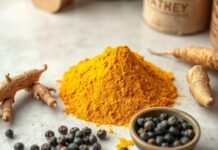
It may. Mustard seed contains active myrosinase, so adding mustard powder to cooked broccoli can supply enzyme after cooking has reduced the broccoli’s own. In a randomized crossover trial, Olukayode Okunade and colleagues compared 200 g (about 7 oz) of cooked broccoli eaten with or without 1 g of powdered brown mustard. Twelve healthy adults took part. The researchers measured a sulforaphane breakdown product in urine over the following 24 hours; the amount was more than four times higher with mustard powder.
That is evidence of increased sulforaphane bioavailability—the body’s measurable uptake and processing of the compound—not evidence that mustard prevents disease or improves health outcomes. The trial was small and tested one specific amount of mustard with cooked broccoli. It supports mustard powder as a possible kitchen option, not a guarantee of a particular effect for every meal or person.
Fresh and frozen broccoli are not equivalent in these studies
Commercial frozen broccoli is usually blanched before freezing. That brief heat treatment can destroy much of its myrosinase activity. In a 2012 randomized comparison, Shikha Saha and colleagues studied 18 healthy volunteers who ate lightly cooked broccoli soups made from fresh or commercial frozen florets. They measured sulforaphane-related compounds in blood and urine and found about tenfold higher sulforaphane bioavailability after the fresh-broccoli soups. The researchers attributed the difference to myrosinase loss during commercial blanching and freezing.
This result applies to the soups and products tested; it does not mean frozen broccoli has no nutritional value or that every frozen product will produce the same result. Gut bacteria can also help convert glucoraphanin, but this route varies between people. The study found evidence of that microbial conversion, not a way to predict how much sulforaphane any individual will absorb.
If frozen broccoli is what you have, it is still a useful food to cook and eat. Adding mustard powder after cooking is a plausible way to supply myrosinase, but the mustard trial was not a direct comparison of frozen and fresh broccoli. So it cannot establish that this fully closes the difference seen in the frozen-broccoli study.
More absorption does not prove a health benefit
Preparation studies can show that more sulforaphane or its metabolites appear in blood or urine. Those measurements help researchers understand availability and metabolism. They do not, by themselves, show that a cooking technique lowers cancer risk or produces another clinical benefit. Claims about disease prevention require evidence measuring health outcomes, not just a change in a biomarker.
For a practical balance, chop fresh broccoli ahead of cooking and let it stand if convenient. Consider a little mustard powder after cooking if you like the taste, especially when cooking has inactivated the plant enzyme. Choose fresh or frozen according to preference, access and convenience; the findings do not make one a poor choice for everyone.