







If you are weighing soy and breast cancer survivors’ concerns, the short answer is that ordinary soy foods such as tofu, tempeh and soy milk appear safe after treatment, including for people with estrogen-receptor-positive (ER-positive) disease. Observational studies link soy food intake after diagnosis with fewer recurrences, but they cannot prove that soy itself prevents cancer from returning. Concentrated isoflavone supplements are a different question and are not covered by the same reassurance.
Soy and breast cancer survivors: what studies suggest
A large prospective study in Shanghai followed 5,042 women diagnosed with breast cancer between 2002 and 2006. Researchers tracked food intake, recurrence and survival over a median of 3.9 years. Women who reported higher soy food intake had lower recurrence and death rates than women reporting less. The association appeared in women with both ER-positive and ER-negative cancers, and in tamoxifen users as well as non-users.
A later pooled analysis combined data from 9,514 women in two US cohorts and one Chinese cohort. Participants had invasive breast cancer diagnosed between 1991 and 2006 and were followed for an average of 7.4 years. Intake of at least 10 milligrams of soy isoflavones a day was associated with a 25% lower relative risk of recurrence. The association with lower breast-cancer-specific and overall mortality was not statistically significant, so this study does not establish a survival benefit.
These studies followed people’s eating habits rather than assigning them to eat soy or avoid it. Other differences between people who ate more or less soy could help explain the results. The findings are reassuring against the idea that normal soy foods increase recurrence, but they do not show that adding soy will improve an individual’s prognosis.
What about ER-positive cancer and hormone therapy?
Soy contains isoflavones, compounds that can bind to estrogen receptors. That has raised concern that soy might act like estrogen and affect hormone-sensitive cancer. But the 2025 review by Mark Messina and Sarah Nechuta concluded that clinical research has not found adverse effects on breast-cancer risk markers such as breast-cell proliferation or mammographic density. Their review also found that limited observational data do not indicate interference with tamoxifen or aromatase inhibitors.
The distinction between evidence and certainty matters here: data on people taking aromatase inhibitors are limited, and observational findings cannot rule out every possible interaction. Still, the available treatment-specific findings do not support routinely avoiding soy foods. If you have ER-positive disease and questions about your own treatment, you can also read our guide to soy foods after ER-positive breast cancer.
Whole foods are not the same as isoflavone supplements
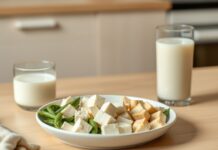
Tofu, tempeh, edamame and soy milk provide isoflavones as part of food. Supplements can deliver concentrated amounts in a different form, and long-term safety findings for ordinary foods should not be applied to high-dose capsules or extracts. A 2013 systematic review found no clear evidence of harm from soy, but said evidence was not strong enough to recommend high-dose isoflavone supplements for people with breast cancer.
Messina and Nechuta’s 2025 review suggests limiting intake to no more than two servings of traditional Asian soy foods a day, providing about 50 milligrams of isoflavones. They explain that this is a cautious limit because few population studies included people eating more—not because higher amounts have been shown to be harmful. Serving sizes and isoflavone levels vary by food and product, so this is not a precise supplement dose.
What to do with this information
If you enjoy soy foods, the findings offer reassurance that you do not need to eliminate them simply because your cancer was ER-positive or you take tamoxifen or an aromatase inhibitor. Treat supplements separately: speak with your oncologist or oncology dietitian before using concentrated isoflavones, especially during treatment.
Research reviews can summarize findings, but they do not establish a single official recommendation from cancer and nutrition organizations across countries. Ask your care team what guidance applies where you live and whether it refers to whole foods, supplements or both. A clinician or oncology dietitian can help if you have questions about your treatment, diet or a supplement you are considering.