












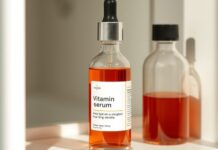








Vitamin C serums may gradually improve some signs of photoaging and uneven pigmentation, but they are not a guaranteed fix. The vitamin c benefits for skin depend on more than the percentage on the label: the form of vitamin C, the rest of the formula, and how well it stays stable all matter. Clinical studies are promising, but small and varied, so a serum is best viewed as one possible part of a routine—not a replacement for sun protection.
What Vitamin C Benefits For Skin Are Supported?
Vitamin C has roles in antioxidant protection, collagen production and the processes involved in pigment formation. Those biological effects give researchers good reasons to study it, but they do not by themselves prove that a particular store-bought serum will produce a visible result.
A 2023 systematic review by Gabriela Correia and Sofia Magina examined prospective randomized trials of topical vitamin C for melasma or sun-related skin damage. The seven included publications involved 139 volunteers. Some reported smoother, less wrinkled skin and measurable lightening in treated areas. Hydration improved similarly in vitamin C and placebo-treated areas, so that benefit could not be attributed to vitamin C. The authors said longer use may be needed and that more research is needed to establish the best concentration.
One example of why results need careful interpretation is a 2020 split-face randomized trial by Pattarawan Rattanawiwatpong and colleagues. It involved 50 Thai women aged 30–65, who applied an encapsulated serum to one side of the face for eight weeks. The product contained 20% vitamin C along with vitamin E and raspberry leaf extract. Researchers recorded improvements in skin colour, elasticity, radiance and some wrinkle measures; mild tingling and tightness were reported. Because the product combined ingredients—and participants continued their usual skincare—the findings cannot show that vitamin C alone caused the changes. Nor does one short study establish how well other products or populations will respond.
Why Formulation And Packaging Matter
L-ascorbic acid, the form of vitamin C with the strongest clinical track record, is prone to oxidation and can be difficult to deliver through the skin. It generally needs a low-pH formula to penetrate effectively; that acidity can also feel harsh for some people. Exposure to oxygen and high temperatures can contribute to its breakdown, so a carefully designed formula and packaging that limits exposure are sensible features to look for. A dark or opaque, well-sealed container may help protect a product, but packaging alone cannot prove that a serum is stable or effective.
Products may instead use vitamin C derivatives, which can be more stable but do not all have the same evidence or skin penetration. A derivative is not automatically better or gentler, and results from one ingredient form cannot be assumed to apply to another. Look for the specific vitamin C form on the ingredient list, along with clear concentration and storage or expiry information. Marketing terms such as “brightening complex” do not tell you how much active ingredient is present or how it is formulated.
More is not necessarily better. High concentrations of acidic L-ascorbic acid can irritate, and one review of consumer products notes that concentrations above 20% have not been shown to increase its effect. The ideal concentration for visible benefit has not been settled, so a higher percentage is not a reliable shortcut to better results.
Choosing A Serum And Reducing Irritation
If you have sensitive skin, start by prioritizing tolerability over a high concentration. Try a new product on a small area first and introduce it cautiously rather than adding several new active products at once. Stinging, burning, redness or itching can be signs that your skin is not tolerating the formula; stop using it if irritation persists, and ask a clinician for advice if symptoms are severe or do not settle.
For uneven pigmentation, set realistic expectations: changes may take time, and vitamin C is not a substitute for protecting skin from ultraviolet exposure. Use sun protection as part of your routine. If dark patches are persistent, worsening or concerning, a clinician can help identify their cause and discuss suitable options. For a closer look at choosing a product for dark spots, see how to compare vitamin C serums for uneven tone.
In short, topical vitamin C has plausible benefits and early clinical support for photoaging and uneven pigmentation, but the evidence does not establish one universally effective formula. Choose by ingredient form, a clearly described formula, protective packaging and how your skin tolerates it—not by the boldest percentage or broadest promise.