





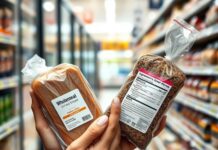
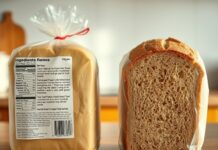
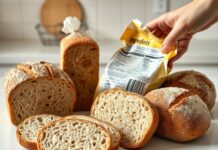












To identify whole wheat bread, start with the ingredient list, not the loaf’s color or the largest words on the front. Look for a whole-grain flour—such as whole wheat flour—as the first grain ingredient. “Multigrain” only means the bread contains more than one type of grain; those grains may be refined.
What “Whole Wheat” Means on a Bread Label
A whole grain retains its bran, germ and starchy endosperm in their usual proportions. Refining removes some of these parts. In bread, the clearest clue is a specific ingredient name that says the flour is whole grain: for example, whole wheat flour, wholemeal wheat flour or whole rye flour.
By contrast, wheat flour or wheat alone identifies the grain, not whether it is whole. In the US, plain “wheat bread” can therefore be made with refined flour. “Multigrain,” “seven grain,” “stoneground,” “country” and “seeded” also do not, by themselves, tell you how much whole grain the bread contains. Seeds and a dark color are not proof either; ingredients such as molasses can darken a loaf.
Check the Ingredients, Then the Nutrition Panel
Ingredients are generally listed in descending order by weight. If a whole-grain flour is the first grain ingredient, it is likely the main grain in the loaf. If refined flour appears first and wholemeal or whole wheat flour comes later, the bread contains whole grain but may not be predominantly whole grain. When a percentage is listed, it helps you see how much is included. A small amount of visible seeds or grains on the crust does not establish the amount inside.
Next, check the nutrition panel for fiber. Compare similar breads using the same basis: ideally per 100 g, or per slice if slice weights are similar. Serving sizes differ, so a higher figure per serving can simply reflect a larger slice. Fiber is useful when comparing nutrition, but it cannot confirm whole-grain content. Refined bread can contain added fiber, while whole-grain bread may not have an especially high fiber figure.
Use the panel to compare other details that matter to you, such as sodium or sugars. A whole-grain claim does not automatically make one loaf nutritionally better in every respect. For a closer look at flour names and label wording, see this guide to whole wheat versus whole grain.
Why the Rules Differ by Region
There is no single global threshold for how much whole grain a bread must contain before it can be called a whole-grain food. That means front-of-pack wording and logos are not equally informative everywhere.
- United States: The FDA’s 2006 draft guidance describes whole grain in terms of retaining the bran, germ and endosperm in their usual proportions. The document is nonbinding guidance, not a rule setting one minimum whole-grain percentage for every bread labeled “whole grain.” Check the ingredient list rather than assuming a broad front-label claim tells you the proportion.
- United Kingdom: A 2024 discussion of UK policy describes no clear regulatory context for whole-grain claims. “Wholemeal” is a useful clue to look for, but check the ingredients and any stated percentage rather than treating the word alone as a measure of how much whole grain is present.
- European Union: There is no single EU-wide minimum threshold for a bread to qualify as whole grain, and national approaches differ. Look for the percentage of whole-grain flour in the ingredient information where it is provided; a general front-label phrase may not make comparisons between countries straightforward.
- Australia: Food Standards Australia New Zealand defines whole grain by the grain’s components, but does not regulate the amount-of-whole-grain claims described in the Australian voluntary code. Under that code, “contains whole grain” corresponds to at least 8 g per manufacturer’s serve; “high” and “very high” correspond to at least 16 g and 24 g. Serve sizes can vary, so check the stated amount and serving size.
These differences matter when comparing imported loaves or products with different certification marks. A logo can be a helpful shortcut if you know what its criteria mean; otherwise, the named flour and a clear percentage are more informative than a general phrase such as “wholesome” or “multigrain.”
A Quick Label Check
When choosing between loaves, look for a whole-grain flour near the start of the ingredients, check whether a percentage is stated, and compare fiber per 100 g or per similar-sized slice. Treat “wheat,” “multigrain” and color as clues to investigate, not proof. This approach can identify what the bread contains; it does not, on its own, establish that one loaf is the right choice for your overall diet.