











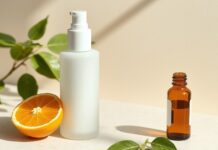









Vitamin c benefits for skin depend on more than the percentage on the bottle. L-ascorbic acid is the form with the strongest clinical validation for photoaging and uneven pigmentation, but it is unstable and needs a suitable formula to reach the skin. Derivatives may offer better stability or tolerability, yet their results are not interchangeable with those of L-ascorbic acid.
What vitamin c benefits for skin can a serum realistically offer?
Vitamin C acts as an antioxidant, supports collagen formation and can interfere with melanin production. These roles help explain why topical products are studied for fine lines and dark spots. They do not mean a serum will erase wrinkles, prevent all sun damage or treat every cause of pigmentation.
A 2026 systematic review by Tanya Boghosian and colleagues examined 44 papers published from 2020 onward, selected from 263 publications screened. It covered topical, injectable and systemic vitamin C, and concluded that outcomes depend on the vitamin C form, vehicle, pH, stabilization and delivery method. The authors also noted that varied study methods and limited standardized data—particularly across different skin phototypes—make direct comparisons difficult.
Pigmentation research has similar limits. In a 2020 systematic review, Rizwan M. Sanadi and Revati S. Deshmukh found seven eligible studies: one randomized trial and six experimental studies. The studies used different forms and routes of vitamin C, so their findings do not establish how well a particular over-the-counter serum works on facial dark spots.
L-ascorbic acid versus vitamin C derivatives
L-ascorbic acid is the direct, active form of vitamin C used in skin products and remains the best-validated option in clinical research. Its drawback is instability: it can oxidize when exposed to air, and it is difficult to deliver through the skin’s outer barrier.
Products may instead use derivatives such as ascorbyl glucoside, sodium ascorbyl phosphate, magnesium ascorbyl phosphate, 3-O-ethyl ascorbic acid or tetrahexyldecyl ascorbate. Some are more stable, and review findings suggest certain derivatives may help with pigmentation or skin texture. But stability alone does not prove that a derivative penetrates well or works as effectively as L-ascorbic acid. Results for one derivative or product should not be assumed to apply to every serum using a similar ingredient.
Why concentration, pH and packaging matter
For L-ascorbic acid, a low-pH formula—often below pH 4—is used to support skin penetration. That does not make every low-pH serum suitable for every person. An acidic product may sting, especially if your skin is already reactive. A higher percentage is not automatically more effective: the studies summarized in the 2026 review do not establish one ideal strength for everyone or show that the highest concentration works best.
Because L-ascorbic acid is vulnerable to oxidation, packaging that limits air exposure is a useful consideration. An opaque, well-sealed pump can reduce exposure compared with a clear bottle that is opened frequently, though packaging cannot guarantee a product will remain stable. Follow the label’s storage and use instructions, and close the container promptly.
How to spot oxidation or irritation
Some L-ascorbic acid serums darken as they oxidize. A noticeable change toward deep yellow, orange or brown can be a warning sign, particularly if the serum was originally clear or pale. But colour alone cannot confirm how much potency remains, and different formulas may have different starting colours. Check the product’s expiry or period-after-opening guidance and contact the manufacturer if you are unsure. For more detail, see how colour can help you assess an oxidized vitamin C serum.
Brief tingling can happen with some products, but ongoing burning, redness, itching or swelling is a reason to stop using the serum rather than push through. Reactions can relate to the formula or other ingredients, not just vitamin C. If symptoms are severe or persist after stopping, seek advice from a clinician.
Make the choice fit your routine
If you want the form with the clearest clinical track record, look for L-ascorbic acid in a clearly labelled, well-sealed formula. If you prefer a derivative, compare the specific ingredient rather than relying on the word “vitamin C” alone, and remember that evidence for one derivative may not transfer to another. Choose a product your skin can tolerate and use it consistently according to its directions.
Vitamin C is not a substitute for sun protection. If photoaging or uneven tone is your concern, use sunscreen as part of your daytime routine; a serum can complement that step, not replace it. If pigmentation is new, changing or worrying, or you are unsure what is causing it, ask a clinician for guidance.