









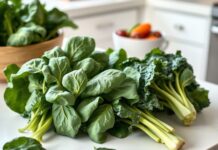











Boiling can lower the soluble oxalate in high oxalate vegetables more than steaming. If you pour away the cooking water, you also discard much of the oxalate that moved into it. But the size of the reduction varies by vegetable, and the available figures do not give a spinach-specific percentage. Boiling also changes other compounds in greens, so it is one preparation option—not a reason to avoid every leafy vegetable.
How Cooking High Oxalate Vegetables Changes Oxalate
Oxalate occurs in soluble and insoluble forms. In a 2005 laboratory study, Weiwen Chai and Michael Liebman, affiliated with the University of Wyoming, measured oxalate in nine types of raw and cooked vegetables. The researchers found that boiling reduced soluble oxalate by 30–87%, compared with 5–53% for steaming. The study’s abstract reports ranges across the vegetables tested, rather than a spinach-specific result.
The researchers also measured oxalate in cooking water and recovered approximately all of the oxalate losses there. That suggests boiling mainly moves soluble oxalate from the vegetable into the water, rather than making it disappear. If you discard the water, less of that transferred oxalate ends up in your meal. If you use the liquid in soup or sauce, you may eat some of it after all. Steaming can also move some oxalate into the water beneath the food, but the reported reduction was generally smaller.
These figures come from one comparison of nine vegetables and should not be treated as a guaranteed reduction for every spinach variety, portion, or cooking method. Still, the results support a useful kitchen distinction: boiling and draining is more likely to lower the oxalate you eat than eating the vegetable raw or steaming it, while keeping the cooking liquid changes the calculation.
Which Vegetables Are Highest In Oxalate?
Spinach, rhubarb, Swiss chard, and sorrel are among the foods with notably high reported oxalate levels; taro leaves can also contain substantial amounts. A 2023 review found published spinach measurements ranging widely, from about 330 to 2,350 mg of total oxalate per 100 g (3.5 oz) of fresh weight. It reported about 1,235 mg per 100 g for rhubarb, and 874–1,458 mg per 100 g for Swiss chard. Sorrel was reported at about 1,079 mg of soluble oxalate per 100 g. These figures use different measurements and are not a precise head-to-head ranking.
Beets are also identified as an oxalate-rich food in a review of kidney-stone diets. Levels can vary with plant variety and growing conditions, as well as how a food sample is prepared and tested. So a food list can help you spot foods worth asking about, but it cannot predict the effect of a particular serving on your own urine oxalate.
Cooking Changes More Than Oxalate
Boiling and draining can also carry some food compounds into the discarded water. A study of pumpkin leaves, for example, compared boiling, steaming, microwaving, and stir-frying. All four methods reduced oxalate by more than 50% in those leaves, but they also reduced measured antioxidant activity. Some phenolic compounds increased; boiled leaves had the highest total phenolics, while steamed leaves had the highest antioxidant capacity.
Pumpkin leaves are not spinach, and measurements of antioxidant activity and phenolics do not tell you how much of every vitamin or mineral remains in a cooked serving. The study does show why “less oxalate” does not automatically mean “better overall”: preparation can shift several food components at once, and the result depends on what was measured.
Kidney Stones Don’t Mean Avoiding All Greens
If you have had a calcium oxalate kidney stone, your food choices may matter—but a blanket ban on leafy greens is not the only or necessarily appropriate response. Stone risk can depend on more than dietary oxalate, and dietary management should be individualized. A review of stone care notes that reducing dietary calcium can increase oxalate absorption, because calcium in the gut can bind oxalate. Do not cut calcium without discussing your situation with a clinician.
Your stone type, urine test results, health history, and usual diet can all help guide advice. A clinician or registered dietitian familiar with kidney stones can help decide whether changing particular foods or cooking methods makes sense for you. For more on one relevant factor, see why calcium with meals matters when eating foods high in oxalate.
For everyday cooking, boiling high-oxalate greens and discarding the water is a reasonable way to reduce the soluble oxalate you eat. Steaming may lower it less, while raw greens retain what they started with. The size of the change for spinach specifically is not established by the reported study, and your dietary needs may call for a more tailored plan.