

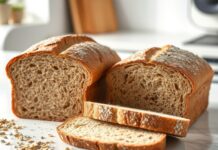


















To tell whether a loaf is genuinely wholegrain, check the flour ingredients—not its colour or a prominent claim on the front. The difference in whole wheat vs whole grain is that whole wheat refers to wheat with its bran, germ and endosperm retained, while whole grain can also refer to other grains, such as oats, rye or rice. Labels and rules differ by country, so the ingredient list is your best starting point.
What The Ingredients Can Tell You
A whole grain keeps the kernel’s three main parts—the bran, germ and starchy endosperm—in their original relative proportions. Milling or rolling the grain does not automatically make it refined: flour or rolled oats can still be wholegrain if those parts remain. Refined flour, by contrast, has had some of the kernel removed.
Look for named ingredients such as whole wheat flour, wholemeal flour, whole rye or whole oats. These names describe grain ingredients; a loaf can still combine them with refined flour. Check the entire list, not just the first words on the pack. If a percentage of wholegrain ingredients is given, it offers a clearer comparison between loaves than a general front-of-pack claim.
Also separate wholegrain content from fibre content. Fibre can be added to bread, and a fibre figure alone does not establish that its flour is wholegrain. A higher fibre number may be useful information, but it answers a different question.
Whole Wheat Vs Whole Grain: Brown And Multigrain Aren’t Proof
Whole wheat is one kind of wholegrain bread: the grain is wheat. Whole grain can describe bread made with other whole grains, or a mix. But multigrain only says that more than one grain is present; it does not tell you whether those grains are whole or refined. Likewise, brown bread’s colour is not proof that it is wholegrain. Check which flours are listed.
Terms such as 100% whole wheat or 100% whole grain sound precise, but how claims are regulated varies. If you want a closer look at wording and ingredient lists, see this guide to telling whether bread is truly whole grain.
How The Rules Differ By Region
- United States: FDA guidance on whole-grain label statements is a draft, nonbinding document, not a rule setting a universal minimum wholegrain percentage for bread. The FDA recognizes a standard of identity for whole wheat flour, but the word whole grain on a package does not, by itself, tell you the loaf’s percentage. Look for a percentage or a clear ingredient list.
- United Kingdom: A 2024 paper on UK food policy describes the country as lacking a clear regulatory context for wholegrain foods. Don’t assume a front-of-pack phrase guarantees that wholegrain flour makes up most of the loaf; inspect the ingredients and any stated percentage.
- European Union: Rules are not uniform across member countries. Ingredient-quantity declarations can show the percentage of a highlighted ingredient, but national approaches to when bread may be called wholegrain differ. A general EU-wide threshold cannot be inferred from the label term alone.
- Australia: Food Standards Australia New Zealand defines what counts as a whole-grain ingredient, including wholemeal, but does not regulate claims about the amount of whole grain in a food. A voluntary industry code exists, so a percentage claim may help you compare products; the wording alone may not settle how much wholegrain the loaf contains.
These differences matter: a claim that sounds definitive in one place may not carry the same threshold elsewhere. An international expert consensus published in 2021 proposed that a food should contain at least 50% wholegrain ingredients by dry weight to be called a whole-grain food, with a presence claim possible at 25–50%. That is a proposed global definition, not a single rule applied to every loaf in these regions.
A Quick Label Check
- Find the flour and grain ingredients, and look for the word whole or wholemeal.
- Check whether refined flour also appears; a loaf can contain both whole and refined grains.
- Use a stated wholegrain percentage to compare similar breads. Don’t treat colour, “multigrain,” or fibre alone as proof.
Wholegrain bread can be one way to choose grains that retain the bran and germ, but the package should help you understand what you are buying. When the claim is broad and no percentage is provided, the ingredient list is the more useful clue.