

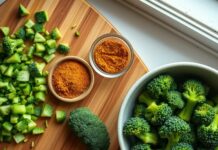




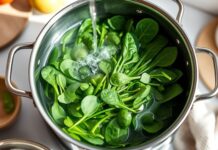











If you’re wondering how to cook broccoli to preserve sulforaphane, two simple ideas are to chop it before heating and, if you cook it, add a little mustard powder afterward. Both have a sound biochemical basis. But the chopping-and-resting step has not been shown here to have a specific, proven timing, and higher sulforaphane absorption is not the same as proof of better health.
How to cook broccoli: Why chopping and resting may help
Broccoli contains glucoraphanin, a compound that can be converted into sulforaphane by an enzyme called myrosinase. In intact plant tissue, the two are kept apart. Chopping breaks cells and brings them into contact. Heat can then inactivate myrosinase, reducing the enzyme’s ability to make that conversion.
That makes chopping before cooking—and leaving the pieces briefly before they meet heat—a plausible way to give the reaction a head start. The important limitation is that the studies described here do not establish an ideal resting time or show that a particular wait reliably improves health outcomes in people. Treat the pause as a reasonable kitchen option, not a required formula. You can chop while preparing the rest of the meal rather than watching a timer.
Cooking experiments also show why methods matter: boiling broccoli can inactivate myrosinase and prevent significant sulforaphane formation during preparation. That does not mean boiled broccoli has no value; it means this particular enzyme-driven conversion may be reduced. The findings don’t establish one best method for every kitchen, recipe or preference.
Can mustard powder help cooked broccoli?
It may. Mustard seeds contain myrosinase, so ground mustard can supply active enzyme after broccoli’s own has been affected by cooking. For a food test, researchers Sameer Khalil Ghawi, Lisa Methven and Keshavan Niranjan found that adding powdered mustard seeds to heat-processed broccoli increased sulforaphane formation. A later human study tested whether that effect showed up in people.
In a 2018 randomized crossover study, Olukayode Okunade and colleagues gave 12 healthy adults 200 g (about 7 oz) of cooked broccoli, with or without 1 g of powdered brown mustard. The researchers measured sulforaphane’s urinary metabolite over the following 24 hours. Average urinary levels were more than four times higher when participants ate the broccoli with mustard powder than when they ate broccoli alone.
For your plate, the tested approach was to mix mustard powder with cooked broccoli, rather than cook the powder with it. The result supports mustard powder as a practical way to increase a measure of sulforaphane availability after cooking. It does not show that every mustard product, amount or recipe will have the same effect. If you want more detail on preparation choices, see this guide to chopping, resting and cooking broccoli.
What the human findings do—and don’t—show
The 2018 trial measured a metabolite in urine, not disease rates, symptoms or long-term health. Its result suggests that more sulforaphane was absorbed and processed when mustard powder accompanied the cooked broccoli. With only 12 healthy adults and a specific serving and ingredient, it cannot establish what happens for everyone or whether the change prevents or treats illness.
That distinction matters: a change in a biological marker can help researchers understand how food compounds are handled, but it is not itself proof of a health benefit. The trial also does not compare all broccoli cooking methods or determine whether chopping and resting before cooking improves human health.
A sensible takeaway is to use these steps if they fit your routine: chop ahead when convenient, cook broccoli the way you enjoy it, and try a little powdered brown mustard after cooking if you like the flavor. Sulforaphane formation is one consideration, not a reason to make broccoli preparation rigid or to expect a guaranteed health outcome.