

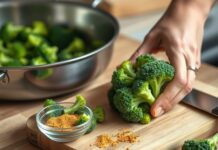
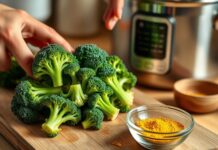
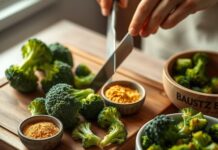












If you’re wondering how to cook broccoli while keeping sulforaphane in mind, focus on the enzyme that helps form it. Chopping can bring that enzyme into contact with its raw material; cooking can reduce its activity. A little powdered brown mustard added to cooked broccoli has increased sulforaphane-related measures in small human studies. None of those changes proves that a particular preparation prevents disease.
How To Cook Broccoli With Sulforaphane In Mind
Broccoli contains glucoraphanin, a compound that can be converted into sulforaphane. The conversion depends in part on myrosinase, an enzyme stored separately from glucoraphanin in intact plant tissue. When you cut, crush or chew broccoli, the cells break open and the two can meet.
That is why chopping matters: it starts the reaction before you eat. But the amount of sulforaphane that forms can vary, and heat can deactivate myrosinase. A study by Vanessa Rungapamestry and colleagues tested 12 volunteers who ate broccoli microwaved for either 2 minutes or 5.5 minutes. The estimated sulforaphane yield in the body was about three times higher after the lightly cooked broccoli. This small study compared specific microwave timings; it does not establish a best setting for every cooking method, broccoli variety or kitchen.
Does Chopping And Resting Broccoli Help?
Chopping before cooking gives myrosinase and glucoraphanin a chance to meet while the enzyme is still active. It is reasonable to cut the florets before they go into the pan or steamer rather than relying on chewing alone. However, the studies described here do not establish a particular resting time—such as 10 or 30 minutes—as necessary or optimal. Treat a pre-cooking pause as an option, not a proven rule.
Cooking method and duration also matter. Heat can limit myrosinase activity, while boiling can allow some compounds to leach into the water. Results differ across vegetables and cooking conditions, so a finding from cabbage or broccolini should not be treated as a precise broccoli recipe. Steaming or a shorter cooking time may preserve more of some compounds than prolonged cooking, but the best choice also depends on the texture and taste you want. For more everyday cooking context, see how different broccoli cooking methods affect sulforaphane.
What Mustard Powder Adds To Cooked Broccoli
Powdered brown mustard is a source of myrosinase. Adding it to cooked broccoli can supply active enzyme after heat has reduced the broccoli’s own. In a randomized crossover study, Olukayode Okunade and colleagues gave 12 healthy adults 200 g of cooked broccoli, with or without 1 g of powdered brown mustard. The amount of a sulforaphane metabolite measured in their urine over the following 24 hours was more than four times higher when they ate the mustard powder with the broccoli.
That result supports mustard powder as a way to increase sulforaphane formation or availability after cooking. It does not mean every product or serving will produce the same increase. The study tested powdered brown mustard, not prepared mustard sauce, and measured a urinary metabolite—not disease outcomes. If you want to try the approach, the study’s powder was added with the cooked broccoli; avoid cooking the powder for a long time, which could expose its enzyme to heat.
A separate study of 11 people with ileostomies found that adding mustard seeds to broccoli soup increased sulforaphane measured in ileal fluid sixfold. The researchers recovered less than 1% of sulforaphane there, and that measurement reflects what reached the end of the small intestine in this specific group. It is not a measure of total absorption or a prediction of health effects.
More Sulforaphane Is Not Proof Of Disease Prevention
Urinary metabolites and measurements in digestive fluids help researchers track formation or passage of compounds. They are not the same as showing that a cooking technique prevents cancer or another disease. The mustard and cooking studies were small and assessed chemical or metabolic outcomes, not whether participants developed disease over time.
Sulforaphane is studied for its biological activity, but a change in its level after a meal cannot by itself establish a clinical benefit. You can choose to chop broccoli before cooking or add brown mustard powder if you enjoy it, but there is no need to treat either step as a guarantee. Broccoli remains a nutritious food whether you steam it, roast it, add it to soup or prepare it another way.