

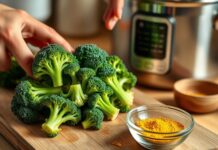















To how to cook broccoli for sulforaphane, focus on the meeting of two compounds: glucoraphanin, a precursor stored in broccoli, and myrosinase, the enzyme that helps convert it into sulforaphane. Cutting or chewing disrupts the plant’s cells and brings them together. Heat can disable myrosinase, so cooking method and time matter—but there is no single kitchen method proven to maximize sulforaphane in every serving.
How to cook broccoli: start with chopping and heat
Whole, undamaged broccoli contains little free sulforaphane; much of its potential is in glucoraphanin. When you chop or chew the florets, cell disruption lets myrosinase act on that precursor. This is why raw broccoli can form sulforaphane after it is cut or eaten, rather than simply containing a fixed amount ready to absorb.
Myrosinase is sensitive to heat. Cooking can reduce its activity, and longer or hotter exposure generally gives it more opportunity to do so. But the result is not just about the enzyme: glucosinolates can also leach into water, and the broccoli’s variety, size and preparation affect what remains. The research does not establish a universal chopping size or resting time that guarantees more sulforaphane.
Raw, steamed and boiled broccoli are not equivalent
Raw: Chopping or chewing brings myrosinase and glucoraphanin together without cooking heat inactivating the enzyme. That makes raw broccoli a straightforward way to preserve the plant’s myrosinase activity. It does not mean every raw serving will produce the same amount of sulforaphane.
Steamed: Steaming uses little water, so it avoids the same direct leaching into a pot of cooking water that can happen with boiling. Brief steaming is often a reasonable compromise if you prefer tender broccoli, but steaming still applies heat and can reduce myrosinase activity. The exact outcome depends on time and temperature; “steamed” alone does not tell you how much sulforaphane will form.
Boiled: Boiling exposes broccoli to heat and water. Heat can inactivate myrosinase, while water-soluble glucosinolates can move into the cooking water. This makes prolonged boiling a less favorable choice if your specific aim is to preserve the conditions for sulforaphane formation. It does not make boiled broccoli nutritionally worthless, and these changes do not establish the overall health value of a meal.
Results from other Brassica vegetables offer useful context, but not a direct ranking for broccoli: a study of broccolini and kale found better retention of glucosinolates and isothiocyanates with steaming than boiling after 15 minutes of cooking. Those vegetables and conditions are not the same as a typical home broccoli preparation. If you enjoy roasting, note that the studies described here do not directly compare a standard roasting method with steaming or boiling.
Can mustard powder help after cooking?
It may. Powdered brown mustard can supply active myrosinase, giving cooked broccoli an enzyme source that heat may have reduced in the vegetable itself. In a randomized crossover study, Olukayode Okunade and colleagues tested 200 g of cooked broccoli with or without 1 g of powdered brown mustard in 12 healthy adults. They measured a sulforaphane metabolite in urine over the following 24 hours. Average urinary levels were more than four times higher when participants ate the broccoli with mustard powder.
The result supports an effect on sulforaphane availability in this small group; it does not show that mustard prevents disease or improves health outcomes. The study location is not specified in the study information described here, so its results should not be treated as a comparison across countries or diets. A separate experiment using cooked broccoli soup also found increased sulforaphane formation after mustard seed powder was added. Together, these findings make mustard powder a plausible kitchen option, not a guarantee of a particular dose.
If you want to try it, stir a little mustard powder into broccoli after cooking rather than cooking the powder along with it. That timing is a practical way to avoid exposing its enzyme to the cooking heat; the studies do not establish an ideal amount for everyday use. For another kitchen-focused overview, see our guide to cooking broccoli.
Formation is not the same as a proven health benefit
These cooking studies measure compounds in broccoli or sulforaphane-related markers in people—not whether one preparation prevents cancer or produces another clinical benefit. A higher urinary metabolite level indicates greater measured exposure in that study, not a guaranteed health outcome. Broccoli can be part of a varied diet whether you eat it raw, steamed or boiled. Choose a method you enjoy, and use brief cooking or mustard powder if increasing sulforaphane formation is a particular interest.