

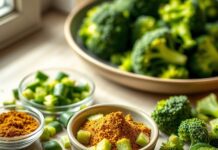










If you’re wondering how to cook broccoli and preserve sulforaphane, the key is the enzyme myrosinase. Chopping breaks open broccoli cells, letting myrosinase act on glucoraphanin, the compound that can be converted into sulforaphane. Heat can inactivate the enzyme. A little powdered brown mustard added to cooked broccoli may help restore that conversion, but it has not been shown to deliver a specific health benefit.
Why Chopping And Resting Can Matter
In intact broccoli, glucoraphanin and myrosinase are kept apart within the plant’s cells. Cutting, chewing or otherwise damaging the tissue brings them together. Myrosinase then helps convert glucoraphanin into sulforaphane, one of several possible breakdown products.
That makes chopping before cooking a reasonable way to let the broccoli’s own enzyme begin working. Resting the pieces before they meet high heat may give the reaction time to occur, too. But the studies summarized here do not establish an ideal home-kitchen resting time or prove that a particular number of minutes produces more sulforaphane. You can chop while you prepare the rest of the meal; treat a longer wait as an option, not a guaranteed technique.
How To Cook Broccoli Without Guessing At The Heat
Myrosinase is heat-sensitive, so prolonged or intense cooking can reduce its activity. In a study of heat-processed broccoli, boiling prevented the formation of significant sulforaphane, and adding powdered mustard seeds increased formation. Another study reported that boiling or steaming broccoli left sulforaphane undetectable under the conditions tested. These findings show why cooking method and time matter; they do not mean every short steam or every household cooking method has the same result.
A 2020 laboratory study by Yingjian Lu, Xinyi Pang and Tianbao Yang tested broccoli samples heated in water or by microwave to controlled temperatures. Sulforaphane increased under some mild-heating conditions, particularly at 50–60°C (122–140°F), but was not detected at 70°C (158°F). Those controlled temperatures are not a ready-made recipe for roasting or microwaving dinner: the researchers monitored sample temperature, and ordinary cooking involves different pieces, equipment and heating patterns. The study is a reminder that “microwaved” or “cooked” alone does not describe the conditions well enough to predict the result.
For everyday cooking, choose a method and texture you enjoy rather than chasing a precise sulforaphane target. If you want to limit enzyme loss, avoid assuming that long boiling is the best choice; brief cooking is a reasonable compromise, though these findings do not define one ideal home method. If you prefer cooked produce for comfort, that preference can matter more than trying to maximize one compound.
Does Mustard Powder After Cooking Help?
It may help with sulforaphane formation and absorption. Mustard seeds contain their own myrosinase, which can act on broccoli’s glucoraphanin even after broccoli’s enzyme has been damaged by heat. In a laboratory processing study, powdered mustard seed increased sulforaphane in heat-processed broccoli.
A small human study gives the idea a useful but limited test. In a randomized crossover study, 12 healthy adults ate 200 g (about 7 oz) of cooked broccoli, either alone or with 1 g (about ¼ teaspoon) of powdered brown mustard. Researchers measured sulforaphane N-acetyl-L-cysteine, a sulforaphane metabolite, in urine collected over 24 hours. Average urinary levels were more than four times higher when participants ate the broccoli with mustard powder.
That result supports adding a small amount of powdered brown mustard to cooked broccoli if you like the taste. The participants ate mustard with cooked broccoli; the study did not establish an exact best moment to add it, a universal dose for every meal, or that all mustard products work equally well. It measured a metabolite in urine—not disease prevention, symptoms or long-term health.
More Sulforaphane Does Not Prove A Health Benefit
Higher sulforaphane formation in a food, or higher levels of its metabolites in urine, tells you something about conversion and short-term exposure. It does not show that a person will avoid cancer or gain a particular health outcome. The mustard study involved only 12 healthy adults and assessed a single meal; it was not designed to test cancer risk or treatment.
So, chop broccoli if that suits your cooking, avoid treating a specific resting time as proven, and use mustard powder as an optional culinary addition. Enjoy broccoli as food, not as a way to prevent or treat disease. If you have a health concern or are considering food or supplements as part of treatment, discuss it with a clinician.