











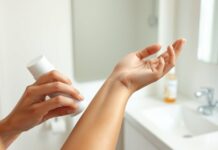
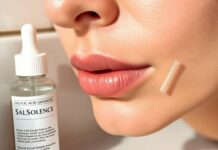





If you're asking “is fake tan safe,” the answer depends partly on how you apply it. DHA (dihydroxyacetone) darkens the outermost skin, not the living skin beneath it, and does not provide sun protection. Lotions and creams make it easier to keep the product on external skin. A spray tan creates a mist that can be harder to keep out of your eyes, mouth, nose and lungs, so take extra care with exposure.
How DHA Creates A Tan—and What It Does Not Do
DHA reacts with amino acids in the skin’s surface layer, producing brown pigments that give skin a tanned appearance. The colour fades as those surface cells are shed. It is a cosmetic effect, not a UV tan: DHA does not stimulate the same process as sunlight or tanning lamps, and a darker-looking complexion is not evidence that your skin is protected.
A 2022 review by Josh Turner and colleagues, published in the Journal of Cosmetic Dermatology, describes this surface reaction and considers DHA’s safety. The authors characterize sunless tanning as a safer way to achieve a tanned appearance than UV exposure. That comparison is about avoiding UV tanning; it does not mean DHA prevents sun damage or that every way of applying it has been fully assessed.
Most self-tanners do not contain sunscreen. Unless a product has sunscreen ingredients and a labelled SPF, use a separate sunscreen as directed when you go outdoors. For more on protecting a commonly overlooked area, see this guide to sun protection for your scalp.
Is Fake Tan Safe? The Application Method Matters
In the United States, the FDA permits DHA as a colour additive for external application to the body. Its rules exclude the lips and surfaces covered by mucous membranes, and DHA is not permitted for use in the eye area. The FDA says it has not received safety data to assess exposure through inhalation, ingestion, or application to these areas. It has not approved DHA for all-over misting in spray-tan booths for those uses.
That distinction matters: the FDA’s position does not establish that a brief exposure will cause harm. It means the safety of those exposure routes has not been established for FDA approval. Reviews of DHA use have also called for more safety research. For a spray tan, the aim is therefore to keep the mist on external skin and away from areas where it could be breathed in or contact sensitive surfaces.
How To Reduce Exposure During A Spray Tan
Before booking, ask the salon how it prevents the spray from reaching your eyes, lips and other mucous membranes, and how it limits inhalation. The FDA advises consumers to request measures that protect these areas and prevent breathing in the mist. If the salon cannot explain how it will do that, choose a different option. A lotion or cream may be easier to apply only where intended.
At home, follow the product label and take care not to get DHA in your eyes, nose or mouth. Avoid spraying toward your face or breathing in the mist; use any protective measures specified by the product instructions. If you cannot keep a spray away from these areas, consider a non-spray formula instead. Do not swallow self-tanner or apply it to lips or mucous membranes.
What US And EU Guidance Can Tell You
The FDA’s US guidance sets out the external-use restriction and highlights the unassessed exposure routes associated with spray booths. Salon practice may also fall under state or local health authorities. This FDA guidance is not an EU-wide rule, and it does not establish whether EU or national requirements use the same restrictions or advice. If you are in the UK, EU or Australia, check the product label and your national cosmetics or consumer-safety authority for local requirements rather than assuming the US rules apply.
Whichever country you are in, a DHA tan is not a substitute for sunscreen or other sun protection. If you develop persistent irritation or have a reaction after using a product, stop using it and seek advice from a clinician.