














Frozen broccoli sulforaphane depends partly on whether the vegetable still has the enzyme myrosinase, which helps convert broccoli’s glucoraphanin into sulforaphane. Chopping fresh broccoli brings the enzyme and its precursor together; cooking can reduce the enzyme’s activity. Mustard powder may help supply active myrosinase after cooking, but more sulforaphane formed or absorbed is not the same as proof of better health outcomes.
Why Chopping And Resting Can Matter
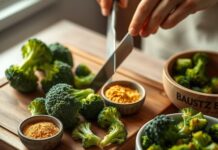
In intact broccoli, myrosinase and glucoraphanin are largely kept apart inside plant cells. Cutting, crushing or chewing breaks down some of those barriers, allowing the enzyme to act on the precursor. That reaction can begin before the broccoli reaches your plate.
For fresh broccoli, chopping it before cooking and leaving it to stand gives the enzyme time to work before heat can inactivate it. However, the human studies described here do not establish an ideal resting time or show that a particular wait improves health. Treat a pause as a reasonable preparation step, not a precise or guaranteed formula.
Cooking Can Reduce Sulforaphane Formation
Heat matters because myrosinase is sensitive to cooking. In a randomized crossover study, Vanessa Rungapamestry and colleagues gave 12 volunteers broccoli cooked in a microwave for either 2 minutes or 5.5 minutes. The researchers estimated that the lightly cooked broccoli produced about three times as much sulforaphane in the body as the fully cooked broccoli, based on urinary metabolite measurements over 24 hours.
That small study measured a marker of sulforaphane production, not disease prevention or another health outcome. It supports the idea that cooking duration can affect how much sulforaphane becomes available; it does not mean you need to eat raw broccoli or avoid cooking it. If preserving enzyme activity is your aim, shorter cooking is a reasonable choice, while the texture you enjoy and food safety still matter.
Frozen Broccoli Sulforaphane: What Changes?
Many frozen vegetables are blanched before freezing. That processing helps prepare the product for storage, but sufficiently high heat can also inactivate myrosinase. In a 2013 food-processing study, Edward B. Dosz and Elizabeth H. Jeffery found that blanching at 86°C (187°F) or higher inactivated the enzyme. At 76°C (169°F), broccoli retained much more myrosinase-dependent sulforaphane-forming capacity. These controlled processing results do not tell you exactly how every brand or country’s product is made.
In the same study, thawing frozen broccoli for nine hours did not, by itself, support sulforaphane formation. Adding an outside source of myrosinase did. A small amount of daikon radish supported formation in the researchers’ tests, including after heating. This was food-processing research, not a human health trial, and it does not establish that all frozen broccoli lacks myrosinase. Products and processing can vary.
Can Mustard Powder Help?
Mustard seed contains myrosinase, so powdered mustard can supply enzyme activity that cooked broccoli may have lost. In a randomized crossover trial, 12 healthy adults ate 200 g (about 7 oz) of cooked broccoli with or without 1 g of powdered brown mustard. The average amount of a sulforaphane metabolite measured in urine was more than four times higher with mustard. The finding shows increased bioavailability in that small study—not a proven health benefit.
For frozen broccoli, the rationale is similar, but the direct frozen-food experiment used daikon, not mustard powder. Human mustard studies tested cooked broccoli, so they do not prove that every mustard product will restore sulforaphane formation in every frozen product. Powdered mustard is the form tested; the results should not automatically be applied to prepared mustard sauces or other condiments.
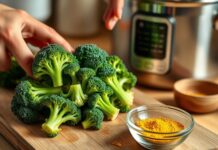
If you want to try it, you can mix powdered mustard into cooked broccoli rather than cooking the powder with it, so its enzyme is not exposed to the same heat. That is a practical application of the enzyme finding, not a proven health strategy. For more on preparation choices, see how cooking methods affect broccoli’s sulforaphane formation.
More Availability Is Not The Same As A Health Benefit
These preparation studies measured sulforaphane in food, or its metabolites in urine and digestive samples. Those measures help explain how preparation affects formation and absorption. They do not show that a particular chopping, resting or mustard routine prevents cancer or improves health. Gut bacteria can also contribute to conversion, and people may differ in how much they produce.
You can use these findings to make an informed cooking choice: cut fresh broccoli before cooking, avoid unnecessarily long cooking if retaining myrosinase is a priority, and consider powdered mustard with cooked broccoli if you want to add another enzyme source. None of these steps is a guarantee of a specific sulforaphane dose or health outcome.