











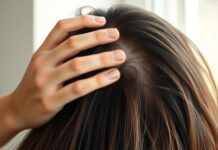









Hair bleach damage can make strands dry, rough and fragile, causing them to snap along the shaft rather than fall out from the root. Pause further chemical processing, handle your hair gently and check whether the fallen hairs are short or broken, or full-length with a root at one end. Scalp pain, blistering or continuing hair loss deserves medical assessment.
What Hair Bleach Damage Does To The Hair Shaft
Bleach lightens hair by oxidising melanin, the pigment inside the cortex. The process can also affect the hair’s keratin proteins and protective outer cuticle. When cuticle scales are disrupted, the cortex beneath is more exposed; damage to this inner structure can leave the fibre less able to withstand everyday handling. Repeated bleaching can add to the damage.
A 2024 laboratory study by Dong Heui Kim, Seung Hyun Oh and Byung Soo Chang examined hair from one donor before and after three bleaching rounds. Under electron microscopes, the researchers observed torn and separated cuticle scales and changes within the cortex. They concluded that excessive bleaching altered hair structure. Because this was a small laboratory experiment using one person’s hair—not a study of people experiencing hair loss—it illustrates how damage can occur but cannot predict what will happen to your hair.
Conditioner can make rough, damaged hair feel smoother and reduce friction during grooming, but it cannot reverse the chemical changes already made to a strand. A deep-conditioning treatment for bleached hair may improve manageability; treat it as care for fragile fibres, not a way to restore them to their original condition.
How To Tell Breakage From Shedding
With breakage, you may find short pieces of different lengths, sometimes with frayed or split ends. The strands have snapped somewhere along the shaft, so they do not have a root end. With shedding, a hair often comes away at its full length and may have a small, club-shaped root at one end. A root can be hard to see, and these clues are not a diagnosis. Both breakage and shedding can happen at the same time.
Bleach acts on the visible hair shaft; it does not, by itself, explain every kind of hair loss. If you notice ongoing shedding, a widening area of thinning, or distinct patches rather than scattered broken strands, arrange an assessment with a clinician. Hair loss can have causes other than chemical damage, and an examination can help distinguish them.
Steps That May Help Limit More Breakage
- Pause bleaching and other chemical treatments. Don’t try to correct the colour with another round while your hair is breaking. Ask a qualified stylist to assess its condition before considering further processing.
- Reduce pulling and friction. Detangle slowly, use conditioner to help the comb move through, and avoid forceful brushing or rubbing with a towel. Hair can be especially vulnerable to friction when wet.
- Use heat sparingly. Lower heat and fewer heat-styling sessions mean less added stress to already fragile lengths. Avoid tight styles that pull on the hair.
- Condition regularly. Conditioner can improve softness and smoothness. Choose a product that suits your hair and follow its directions; no particular repair product can guarantee that broken strands will recover.
These steps may reduce additional wear, but they cannot mend a strand that has already snapped. A stylist can help you decide how to handle damaged lengths and whether further chemical services are appropriate.
When Scalp Symptoms Need Medical Attention
Some discomfort or irritation can occur with hair products, but marked or persistent scalp pain, blistering, raw skin or swelling after bleaching should not be treated as ordinary hair damage. Seek medical advice promptly, especially if symptoms are worsening. If you also used permanent dye or black henna, an allergic reaction is a separate possibility; read about hair-dye allergy symptoms and when to get help.
Hair snapping along its length is different from hair coming away at the root, but you may not be able to tell the cause by appearance alone. Get a clinician’s assessment if hair loss persists, becomes patchy, or concerns you, and seek care for significant scalp symptoms rather than trying another chemical treatment.