















Asbestos in makeup is a legitimate product-safety concern, but it helps to separate three questions: whether talc can be contaminated, how reliably testing detects contamination, and what a test result means for your exposure. Asbestos is a known carcinogen, and inhaling it is a health concern. Yet the risk from using a particular face powder cannot be calculated from the fact that talc is present—or from a small product survey alone.
What Asbestos In Makeup Testing Can—and Cannot—Tell You
Talc is mined from deposits that can contain asbestos minerals. The minerals may be difficult to distinguish from other particles in the ore, so a test needs to identify very small amounts and confirm what the particles are. A negative result is only as useful as the sampling and method behind it.
X-ray diffraction (XRD) can screen samples, but it may not be sensitive or specific enough on its own. Polarized light microscopy (PLM) can identify minerals, yet may miss some particles at low concentrations. Transmission electron microscopy (TEM) can examine much smaller particles and is more sensitive, although it takes more time and expertise. The FDA’s December 2024 proposed testing rule called for PLM with dispersion staining alongside TEM with additional analysis to identify particles. It also proposed allowing manufacturers to rely on a talc supplier’s certificate of analysis. Because that was a proposal, check the FDA for its current status before treating it as a final requirement.
A small 2020 study by Tasha Stoiber, Sean Fitzgerald, and Nneka Leiba tested 21 talc-based cosmetics bought in San Francisco, Washington, DC, and online. Using TEM, the researchers detected asbestos in three products: two eyeshadow palettes and one children’s toy makeup kit. The sample included only three face powders, and none was among the products reported as positive. That does not establish that face powders are free of contamination; the sample was too small to estimate how common contamination is across products or brands. Separately, the FDA reported finding asbestos in 9 of 52 talc-containing cosmetics it tested in 2019. Those results show why test methods matter, not the odds that a powder on your shelf is contaminated.
Inhaling Powder: A Hazard Is Not A Personal Risk Estimate
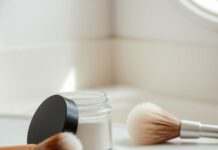
Loose powder can become airborne during application, so breathing in some dust is possible. If asbestos were present, inhalation would be a route of concern. But product tests do not measure how much a person inhales while applying makeup, and the studies described above do not establish the health risk from ordinary face-powder use. The amount released, how often you use the product, and whether it is contaminated all matter; the supplied product findings do not quantify those factors for an individual user.
That distinction also matters when you see headlines about mesothelioma from makeup. Asbestos exposure is linked to mesothelioma, but a product survey does not show that a particular consumer will develop the disease, or establish a rate of illness from face powder use.
Why Genital Talc Findings Do Not Answer The Makeup Question
Research on talc and ovarian cancer has largely examined powder applied to the genital area, a different use and exposure route from applying face powder. Findings about that use cannot automatically be transferred to inhaling makeup dust. The research is also contested: published studies have not all reached the same conclusion, and researchers have identified limits such as imperfect exposure histories. That uncertainty does not prove either that genital talc use causes ovarian cancer or that inhaling cosmetic powder is safe; the questions require different evidence.
How Rules Differ Across Regions
In the United States, the FDA’s December 2024 proposal set out a specific approach to testing talc-containing cosmetics, but its proposal should not be mistaken for a confirmed, current requirement. In the European Union, asbestos is prohibited as a cosmetic ingredient; the United Kingdom’s cosmetics framework is closely aligned with the EU’s. Australia prohibits the import of asbestos-containing goods, subject to limited exceptions, and regulates cosmetic ingredients through its chemical-control system. These rules are not the same thing as proof that every product has been tested using TEM, or that regulators in each region require an identical method. For a specific product or recall, check the relevant national regulator’s current notices.
Ways To Reduce Dust When You Apply Powder
- Use a small amount and press it onto the skin rather than shaking or puffing a cloud into the air.
- Keep the container close to your face and avoid applying loose powder near a fan or open window that could spread it.
- Choose pressed powder or another format if loose powder tends to become airborne during your routine.
- If you contact a brand, ask whether it tests the talc or finished product, which methods it uses, and whether testing covers batches. A general “tested” claim does not tell you those details.
Choosing a talc-free loose face powder avoids talc as an ingredient, but “talc-free” is not a guarantee that a product is risk-free or dust-free. Other powders can also become airborne, and the label alone does not establish the safety of every ingredient or the quality of manufacturing. If you have ongoing breathing symptoms, speak with a clinician; symptoms alone cannot identify their cause.