










The burger internal temp matters because grinding can spread bacteria from beef’s surface throughout a patty. That is why a burger needs thorough cooking all the way through, while an intact steak is often cooked with its centre less done. In the United States, USDA Food Safety and Inspection Service guidance sets the minimum for ground beef at 160°F (about 71°C).
Burger internal temp: why it differs from steak
With an intact cut of beef, any bacteria introduced during handling are generally on the outside. Cooking the exterior thoroughly can reduce that surface risk, even if the centre remains pink. That does not make every rare steak automatically safe: handling and cooking still matter, and this article is not a recommendation to eat undercooked meat.
Grinding changes the picture. Meat passes through equipment and is broken into small pieces, mixing parts of the surface into the centre of the mince. If bacteria are present on the meat, grinding can distribute them through the batch rather than leaving them only on the outside. Shaping that mince into a burger does not put the bacteria back on the surface. Cooking only the patty’s exterior, or leaving the middle underdone, may therefore leave bacteria inside.
This is the key difference between an intact steak and a burger made from minced beef: the burger’s centre needs to reach a safe temperature too. The same reasoning applies to other dishes made with ground beef, not just round patties.
How to check a burger’s temperature
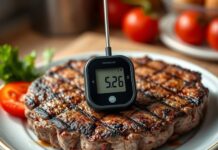
Use a food thermometer rather than judging doneness by colour or cooking time. Insert it into the centre of the thickest part of the patty; for a thin burger, angle the probe from the side so the sensing area reaches the middle. Check more than one patty if they differ in thickness or have cooked unevenly.
For ground beef, USDA FSIS recommends an internal temperature of 160°F (71°C). The reading is for the centre of the meat, not the grill or pan. If a patty has not reached the target, keep cooking and check again. A thermometer is especially useful when burgers are thick, frozen, or cooked over heat that varies across the grill.
Colour is not a dependable substitute for a temperature reading: appearance alone cannot tell you whether the centre has reached the recommended temperature. Nor does a particular shade of pink establish that a burger is safe. If you are cooking for someone at greater risk from foodborne illness, take extra care to follow the food-safety advice from your local authority.
What the temperature guidance says by region
United States: USDA FSIS advises cooking ground beef to at least 160°F (about 71°C), measured with a food thermometer. This is the specific national recommendation stated here.
United Kingdom, European Union and Australia: Temperature figures for these regions are not confirmed here, so it would be misleading to present the U.S. number as a verified local rule or to suggest that all countries in the EU use one target. Check the current advice from the food-safety authority where you live. Some official guidance may express safe cooking as a temperature held for a specified time, so compare both the temperature and any required holding time—not just the number.
In practice, use the guidance for the country where you are cooking, especially if you are following a recipe or using a thermometer marked in only one unit. Celsius and Fahrenheit conversions can be rounded, so follow the local authority’s stated target rather than treating a rounded conversion as an exact alternative.
Keep raw mince separate from ready-to-eat food
Cooking is one part of safe burger preparation. Raw ground beef can transfer bacteria to foods that will not be cooked, even after you have washed your hands or cleaned a surface. Keep raw mince and its utensils separate from salad, buns and cooked food; wash your hands with soap and water before and after handling it. USDA FSIS advises storing ground beef at 40°F (about 4°C) or below and using it within two days, or freezing it.
The simple rule is to treat burgers as ground meat, not as small steaks: cook the centre thoroughly and verify it with a thermometer. For the exact target outside the United States, follow the current official guidance in your region.