

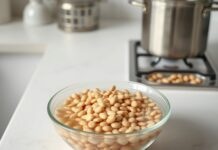

















Soaking can help reduce gas from beans, especially if you drain and discard the soaking water before cooking. Water-soluble carbohydrates linked to gas can move into the soak water, so pouring it away may lower how much reaches your gut. It is not a guarantee of symptom-free beans, and the exact reduction is uncertain: research on cooking methods has not established how much less gas people experience after soaking.
How to Reduce Gas From Beans by Soaking
Dried beans contain fermentable carbohydrates, including raffinose-family sugars. Your small intestine does not fully digest these sugars; gut bacteria ferment them in the large intestine, producing gas. Soaking gives some of these water-soluble compounds a chance to move out of the beans and into the water. If you cook the beans in that same liquid, you keep some of what has leached out.
For a simple trial, soak dried beans in plenty of water for about 12 hours, then drain and rinse them. Cook them in fresh water until tender. That sequence is a reasonable choice if you want to reduce exposure to some soluble carbohydrates, but it cannot remove every fermentable carbohydrate in a bean.
The distinction between soaking and cooking matters. Heat softens beans and makes them edible, but it does not mean every gas-producing carbohydrate disappears. Draining the soak water is the step that removes the compounds that have dissolved into it. If you use the cooking liquid in a soup or sauce, you retain some soluble material that enters that liquid too.
What Soaking Changes Besides Gas
The clearest measured benefit is faster cooking. In a 2022 study, Justice Munthali and colleagues tested eight varieties of common beans in Malawi. The beans were grown at Chitedze Research Station, and soaking and cooking tests took place at the Bunda campus of the Lilongwe University of Agriculture and Natural Resources. The researchers measured cooking time, bean splitting and total soluble solids in the cooking broth—not gas symptoms in people.
After a 12-hour soak, average cooking time fell by about 20% to 38%, depending on the type of water used. Soaking generally also reduced splitting. The study supports soaking as a way to speed cooking and help beans hold together, but it cannot tell you how much it will reduce gas for you or whether one variety will be easier on every person’s digestion.
Discarding the soak water has a trade-off: some water-soluble nutrients and other dissolved compounds can go with it. The Malawi study measured total soluble solids in the broth, not individual vitamins, minerals or the nutritional value of the beans as eaten. It therefore cannot quantify nutrient losses from draining. Keeping cooking liquid in a dish may preserve some compounds that enter that liquid, but it may also keep some fermentable carbohydrates. There is no precise, universal nutrient-versus-gas calculation to guide that choice.
Why Your Response May Differ
People do not all respond to beans in the same way. The amount you eat, the type of bean and how it is prepared can all differ from one meal to another; digestive sensitivity and gut bacteria also vary between people. Soaking may make a noticeable difference for one person and little difference for another. A smaller serving can be a useful way to see how you respond, without assuming you need to avoid beans altogether.
If soaking is inconvenient, it is not essential for every recipe: the study’s results show a cooking-time benefit, not a requirement for safe or digestible beans in general. If you do soak, drain the water and cook in fresh water for the best chance of removing compounds that have leached out. Give the beans enough time to become fully tender; soaking shortens cooking but does not replace it.
If digestive symptoms are severe, persistent or occur with foods beyond beans, speak with a clinician rather than relying only on preparation changes.