















If an imaging report mentions fatty liver, it confirms fat in the liver but does not tell you whether there is significant scarring. Clinicians often start with routine blood results and a calculation called FIB-4, then consider liver elastography if the result or your health history suggests more assessment is needed. The aim is to identify fibrosis—the build-up of scar tissue—not simply to confirm that fat is present.
What Fatty Liver Blood Tests Can—and Can’t—Show
ALT and AST are enzymes measured in routine blood work. They can rise when liver cells are injured, but normal levels do not rule out fibrosis or more advanced disease. Many people with fatty liver have normal liver enzymes, so a reassuring result should not be treated as a complete check of liver health.
FIB-4 is a blood-based risk score calculated from age, AST, ALT and platelet count. It is not a direct test for fat or a diagnosis of liver disease. It helps estimate the chance of advanced fibrosis and decide whether a second test may be useful. A low score can help rule out advanced fibrosis; a higher or borderline score generally needs interpretation alongside your age, health history and other results.
Common pathways use cut-offs around 1.3 and 2.67 for many adults: below 1.3 is generally considered lower risk, 1.3 to 2.67 an intermediate range, and above 2.67 higher risk. These are decision thresholds, not proof that scarring is present or absent. Age matters: FIB-4 is less reliable in people younger than 35, and it can produce more false alarms in people aged 65 or older. Ask how your age affects the interpretation rather than reading the number in isolation.
When Liver Elastography May Be the Next Step
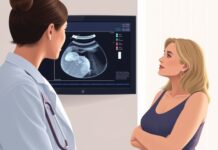
If FIB-4 is not clearly low, or there are other signs of possible progressive liver injury, a clinician may suggest elastography. This test estimates liver stiffness, which can indicate fibrosis. Transient elastography—often called FibroScan—is one type; some ultrasound examinations also use shear-wave elastography. These tests are different from a standard ultrasound, which can show fat but does not reliably stage scarring.
Elastography is non-invasive, but it is not a perfect verdict. Results depend on the method used, and a stiffness reading is not the same as a biopsy diagnosis. A clinician may interpret it with your blood tests and medical context, repeat or add testing if results do not fit together, or refer you to a liver specialist. Biopsy is not routinely needed for everyone with fatty liver, but specialists may consider it when non-invasive results conflict or a more definitive diagnosis is important.
A 2025 meta-analysis by Mitchell Patrick Wilson and colleagues pooled 207 studies involving more than 80,000 patient investigations. It found that FIB-4 and several elastography methods can help identify fibrosis, but test accuracy and useful cut-offs vary by method and purpose. That supports a staged approach—not treating one result as conclusive.
How Guidelines Shape Follow-Up
Major guidance broadly agrees on using risk assessment in stages, but the emphasis and local pathways vary. The 2024 joint guideline from the European Association for the Study of the Liver, the European Association for the Study of Diabetes and the European Association for the Study of Obesity supports case-finding when imaging shows steatosis, liver enzymes are abnormal, or cardiometabolic risks are present—particularly type 2 diabetes or obesity with additional metabolic risk. It describes FIB-4 followed by imaging such as transient elastography as a suitable sequence.
Japan’s 2026 MASLD guideline also names FIB-4 as a first-line tool and recommends considering elastography and specialist referral when the score is elevated or clinical features suggest progressive injury. These approaches are more alike than different in their basic sequence. The test available, referral route and thresholds used can vary by health system, so your clinician should apply the pathway used in your region rather than assume every country uses identical cut-offs.
For more on why normal enzyme results may not settle the question, see this guide to fatty liver with normal tests and fibrosis checks.
What to Ask at Your Follow-Up
Bring the imaging report and ask whether your blood results allow a FIB-4 calculation, what the score means for your age, and whether elastography or repeat assessment is appropriate. Also mention relevant metabolic conditions, alcohol intake, medicines and any known liver disease; these details can affect how the finding is assessed. If you have concerns or your results are unclear, discuss them with a clinician rather than trying to diagnose fibrosis from a single test.