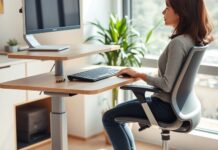



















The clearest standing desk benefits are behavioral: you can replace some workday sitting with standing. That may help break up long seated spells, but a desk does not erase the effects of prolonged sitting or turn standing still into exercise. Research has not established that sit-stand desks reliably improve blood glucose or substantially increase daily energy use.
What standing desk benefits can—and cannot—do
In an eight-week randomized trial at one organization, Lee E. F. Graves and colleagues studied 47 asymptomatic, full-time office workers. Compared with a control group, workers given sit-stand workstations sat about 80 minutes less per eight-hour workday and stood about 73 minutes more. The researchers also observed changes in some cardiovascular and metabolic measures, including lower total cholesterol. The trial was small and short, however, so it cannot show that desks prevent disease or produce lasting health improvements.
A three-month feasibility study by Eleni Mantzari and colleagues followed office employees at two companies in Cambridge, England. The 20 workers who entered its desk trial sat about 94 minutes less at work per day. But the researchers could not draw a clear conclusion about energy expenditure or cardiometabolic outcomes. Sitting less at work, then, is a more dependable result than burning substantially more energy.
Blood glucose deserves particular caution. The findings described in these workplace trials do not establish that a sit-stand desk improves glucose control. A desk may change posture and sitting time, but that is not the same as demonstrating a meaningful blood-sugar effect.
Standing is a change of posture, not a movement break
Standing uses more energy than sitting, but standing in one place is still low-intensity behavior. A desk can make it easier to switch positions while working; it does not provide the same movement as walking or other activity. If you stand for hours without moving, you have traded one static posture for another.
The best schedule for switching positions has not been established. In a six-month trial of 39 office workers in Portugal, Pedro B. Júdice and colleagues found no significant between-group improvement in the primary sitting-time outcome. Some within-group measures changed, but those do not prove that the desk caused the changes. The mixed results matter: a desk’s effect depends partly on whether people use it, and findings from one workplace or country may not transfer directly to every job or work culture.
Rather than chasing a perfect timer, use natural task changes as prompts: stand for a call, sit for focused work, or take a brief walk when you finish a task. Set a gentle reminder if you tend to lose track of time. No single interval is proven to be right for everyone; regular changes and brief activity are more useful goals than standing for a fixed number of hours.
Discomfort may improve, but standing all day can backfire
Discomfort findings are mixed, though some people may feel better when they can change posture. In a one-day laboratory crossover study at the University of Pittsburgh, 25 adults alternated sitting and standing every 30 minutes on one visit and sat for the full workday on another. Overall and back discomfort, physical fatigue and sleepiness were lower during the alternating condition, while leg discomfort was higher. These short-term results do not establish the best schedule for everyday office work.
A 2019 scoping review of 53 studies found that sit-stand desks consistently changed behavior, while health outcomes were less consistent. Discomfort was among the outcomes that appeared most responsive, but the studies varied in size and duration. If prolonged standing makes your legs or back uncomfortable, switch positions rather than trying to push through it.
Set up the desk for easy, comfortable changes
Adjust the desk so your shoulders can relax, your elbows stay close to your sides, and your wrists remain fairly straight while you work. Keep the screen directly in front of you at a height that lets you look ahead without hunching or tilting your head. When seated, support your feet; when standing, wear comfortable shoes and avoid locking your knees. These adjustments help you work in either position, but they do not replace movement.
Keep frequently used items within easy reach, and make changing desk height simple enough that you will actually do it. For more step-by-step setup and posture ideas, see this guide to using a sit-stand desk without standing all day.
A sit-stand desk is best viewed as a tool for reducing workplace sitting—not a complete solution to prolonged inactivity. Alternate postures, add brief walks or other movement where your workday allows, and adjust the routine to your comfort. If standing or sitting brings on persistent pain, consider speaking with a clinician or workplace ergonomics professional.