


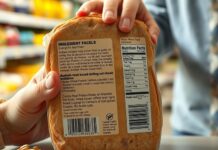


















To tell whether bread is mostly whole grain, look past its colour and front-of-pack name: compare the flour ingredients with the fibre line. The difference between whole wheat vs whole grain matters, too: whole wheat is whole grain made from wheat, while whole grain can also mean oats, rye, barley, maize or other grains.
Whole wheat vs whole grain: What the words mean
A whole grain keeps the kernel’s main parts—the bran, germ and endosperm—in their original proportions. Milling can change the grain’s form, but if the bran and germ are removed and added back in different amounts, the flour is not necessarily whole grain.
“Multigrain” means a product contains more than one kind of grain; it does not tell you whether those grains are whole or refined. “Seeded” tells you seeds are included, often on the crust, but not what flour makes up most of the loaf. “Brown” describes colour, not the proportion of whole-grain ingredients. These words may appear on a genuinely whole-grain loaf, but none proves it on its own.
Check the flour ingredients, then fibre
Look for flour named as whole wheat, wholemeal or whole grain, and check which grain it comes from. If the main flour is listed as refined wheat flour and bran appears separately, the loaf may contain fibre without being made mostly from whole-grain flour. Likewise, seeds or grains sprinkled on top do not tell you how much whole grain is in the bread itself.
Fibre on the nutrition panel is a useful second check: compare similar serving sizes, such as one slice with one slice. A higher fibre value can help you compare loaves, but fibre is not a direct measure of whole-grain content. Bran, seeds and other ingredients can contribute fibre, so the number cannot confirm that the flour is whole grain. For more detail on ingredient wording, see our guide to spotting whole-grain bread on the label.
Why the claim depends on where you shop
There is no single threshold that applies everywhere for when a food can be called “whole grain.” A 2014 expert roundtable proposed that a food contain at least 8 g of whole grain per 30 g serving (about 27 g per 100 g) to count as a whole-grain food. A 2021 global consensus definition proposed a different benchmark: at least 50% whole-grain ingredients by dry weight. These are expert proposals, not one worldwide labelling rule.
In the US, that 2014 benchmark can offer context, but it does not replace checking the loaf’s ingredient list. In the UK, a clear regulatory framework for whole-grain food claims has been lacking, so a fibre figure can be informative without settling how much of the flour is whole grain.
Across the EU, rules and guidance can vary by country. A 2017 Healthgrain Forum perspective noted that when “whole grain” is mentioned on a package, the ingredient amount is declared in the ingredients list, but that can be less visible than a front-of-pack percentage. Check the list rather than assuming every country uses the same threshold.
In Australia, Food Standards Australia New Zealand defines what counts as a whole-grain ingredient, but does not regulate the amount required for an on-pack whole-grain claim. A voluntary industry code suggests “contains whole grain” from 8 g per serve, “high in whole grain” from 16 g and “very high in whole grain” from 24 g. Those figures are guidance under the code, not a rule covering every loaf.
A quick way to choose
Start with the flour: does the ingredient list identify it as whole wheat, wholemeal or another whole grain? Then use fibre as a comparison, not proof. If the package gives a whole-grain percentage or grams per serving, that makes the amount clearer; remember that the meaning of a claim can depend on the country and the standard being used.
These checks help you understand what is in the loaf; they do not determine what is right for your individual diet. If you have a health condition or specific dietary needs, ask a qualified clinician for advice.