











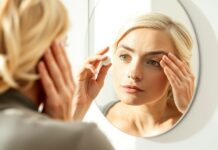









If you’re searching for “what causes bags under eyes,” the answer matters when deciding whether caffeine eye cream is worth trying. It may make mild puffiness or some vascular-looking darkness less noticeable, but human studies are small and often test caffeine alongside other ingredients. A cream cannot address every cause, and lasting results have not been established.
What Causes Bags Under Eyes?
“Bags” and dark circles can look similar, but they do not have one shared cause. Puffiness may come from fluid collecting in the lower eyelid, while a persistent bulge can reflect changes in underlying fat, skin or facial structure. Fluid-related swelling can be more noticeable in the morning. Allergies and other local irritation may also contribute.
Dark circles can result from pigment in the skin, visible blood vessels beneath thin skin, fluid-related changes, or shadows cast by hollows and facial anatomy. The 2016 review Infraorbital Dark Circles: A Review of the Pathogenesis, Evaluation and Treatment, by Ivan Vrcek, Omar Ozgur and Tanuj Nakra, describes these overlapping causes. A shadow caused by a hollow is not the same as brown pigmentation, so a brightening cream may not help both in the same way.
What Human Studies Say About Caffeine Eye Cream
There is a plausible reason caffeine appears in eye products: it can constrict blood vessels, and some formulations aim to reduce the look of vascular congestion or fluid-related puffiness. But a proposed mechanism is not proof that a particular cream will produce a noticeable change.
In a 2015 study, Fatemeh Ahmadraji and Mohammad Ali Shatalebi tested an eye pad containing 3% caffeine and 1% vitamin K in an emu-oil base. Eleven healthy women used the pad under one eye and a water pad under the other for four weeks. The researchers reported improvements in the appearance of dark circles and wrinkles. The small study tested a combination product, however, so it cannot show that caffeine alone caused the changes or that the result applies to every eye cream.
A 2023 open-label study enrolled 40 women aged 35–60 with dark circles and puffiness; 37 completed 12 weeks. The tested cream contained caffeine alongside vitamin C, peptides and several other ingredients, and the researchers reported improvements in measured and participant-rated outcomes. Without a comparison group, the study cannot establish how much improvement came from caffeine, the other ingredients or factors such as expectations.
Hanin Hamie and colleagues’ 2024 review of eye-cream ingredients also notes a shortage of clinical trials on specific eye-cream formulations and differences in study design, sample size and ingredient concentrations. Taken together, the human findings suggest potential, not a reliable or complete fix. They do not establish that caffeine creams remove structural bags or all types of dark circles.
Why Any Effect May Not Last
If caffeine temporarily changes the appearance of blood vessels or fluid-related puffiness, that would not remove a hollow, alter a fat bulge or permanently change pigmentation. The studies above assessed people while they were using the products; they do not establish how long any improvement lasts after use stops. So it is reasonable to view a caffeine cream as a possible cosmetic aid, not a lasting correction.
If you try one, keep expectations modest and follow the product directions. The skin around the eyes is delicate and can be prone to irritation. Contact dermatitis and repeated rubbing can contribute to pigmentation, so a product that causes persistent stinging, redness, itching or swelling is not worth pushing through. Stop using it and seek advice if the reaction continues.
When to Get Under-Eye Changes Checked
Consider a clinician’s assessment if swelling or discoloration persists, changes noticeably, or affects one eye more than the other. A new one-sided change, especially with pain, redness or vision changes, should not be treated as a cosmetic concern alone. A clinician can assess possible causes; this article cannot determine what is behind an individual change.
For a stable, mild concern, the most useful first step is to notice whether you are seeing temporary puffiness, pigment, visible vessels or a shadow. That distinction helps set realistic expectations: caffeine may help the appearance of some fluid- or vessel-related changes, but no cream can be expected to correct every cause.