











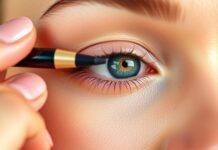









A waterline eye look may define your eyes, but applying eyeliner along the inner eyelid margin puts it closer to your tear film than drawing it just outside the lashes. Studies have found that eyeliner can migrate into tears and that inner-lash-line application leads to more contamination than application on the outer skin. That does not prove tightlining causes lasting damage, but it gives you a reason to choose a less exposed application—especially if your eyes are dry or sensitive.
Waterline Eye Makeup And Tear-Film Migration
The tear film is the thin layer of fluid that coats the eye. Eyeliner applied at the inner lash line can move across the lid margin and into this layer. Blinking may help carry particles toward the eye, although exactly how migration happens is not fully understood.
In a 2018 review, optometry researchers Michael T. M. Wang and Jennifer P. Craig described two small experiments comparing application locations. In a randomized study of 75 participants, a test mixture applied at the inner lash line migrated into the eye sooner and in greater amounts than the same mixture applied farther out. The mixture was made for the experiment and may not behave like every commercial eyeliner.
A separate pilot crossover experiment followed just three participants using a commercially available glitter pencil. It also found less and slower tear-film contamination when the pencil was applied to the skin outside the lash line. In that experiment, contamination generally peaked within 10 minutes and was negligible after two hours. The small sample and the specific products tested mean these results cannot predict exactly what will happen with every formula or person.
What About The Eyelid’s Oil Glands And Dry-Eye Symptoms?
Meibomian glands are oil-producing glands in the eyelids. Their openings sit along the lid margin, where tightlining is applied. The oil they release helps form the outer part of the tear film. Putting makeup at the margin therefore brings it close to both the tear film and these gland openings.
That proximity is a reason for caution, not proof that eyeliner blocks the glands or permanently damages them. Research on cosmetic migration supports the possibility of tear-film contamination and eye discomfort, but it does not establish that waterline eyeliner causes lasting gland injury or dry-eye disease.
Some people may notice burning, watering, irritation or a gritty feeling after makeup migrates into the eye. These symptoms can be consistent with irritation, but they are not specific to eyeliner and do not by themselves show that you have dry-eye disease. If symptoms repeatedly follow tightlining, stop applying it there and see whether the problem settles. You can still define the eyes by placing liner on the skin just outside the lashes, where the experiments found less migration.
How To Reduce Risk, Including With Contact Lenses
- Keep liner outside the inner rim. Applying it just beyond the lashes is the change most directly supported by the migration studies.
- Use clean tools and eye-area products. Avoid sharing applicators, and do not apply makeup with a tool that could slip or scratch the eye.
- Remove makeup gently before bed. Use a remover intended for the eye area; let it loosen the product, then wipe without scrubbing the lid margin. Rubbing can add mechanical irritation.
- If you wear contact lenses, avoid tightlining. The eyeliner studies did not test contact-lens wearers separately, so they cannot quantify extra risk for you. Keeping makeup away from the tear film is a cautious way to limit exposure. Wash and dry your hands before handling lenses, and remove your lenses before taking off eye makeup.
If your eyes are already sensitive or often feel dry, consider skipping waterline application rather than trying several formulas on the inner lid. A product labelled waterproof is not evidence that it is safer there, and the migration experiments do not establish that any particular brand or formula prevents particles from reaching the tear film.
When To Get An Eye-Care Assessment
Stop using the product and arrange an assessment if irritation persists, keeps returning, or comes with marked redness, discharge or a gritty sensation that does not settle. Seek prompt eye-care advice for eye pain, light sensitivity or blurred vision. If you wear contact lenses and develop pain, redness or a change in vision, remove the lenses and contact an eye-care professional promptly. Do not assume ongoing symptoms are simply a reaction to makeup.