











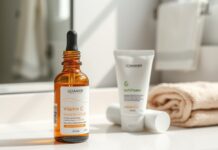
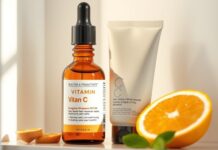







If you are considering vitamin C for dark spots, expect a possible gradual improvement in uneven tone—not a guaranteed erasure. Topical vitamin C may also support skin affected by photoaging, but results depend on the ingredient form, its formulation and how well the product stays stable. It does not block ultraviolet (UV) rays, so it cannot replace sunscreen.
What vitamin C for dark spots can realistically change
Vitamin C can interfere with melanin production and act as an antioxidant. It also contributes to collagen synthesis, which helps explain its use in products aimed at fine lines and other signs of photoaging. These mechanisms make it a plausible option for uneven pigmentation and sun-related skin changes, but they do not mean every spot or wrinkle will respond.
A 2026 systematic review by Tanya Boghosian and colleagues included 44 studies published from 2020 onward. It covered topical, injectable and systemic forms of vitamin C, and found that L-ascorbic acid was the most clinically validated form. The authors also noted that studies varied and lacked standardized data, particularly across skin phototypes. That makes it difficult to predict how much benefit a particular person—or product—will deliver.
A product-specific clinical evaluation tested a stable, water-free 10% L-ascorbic acid formula, measuring pigmentation at the start and after 28 and 56 days. The report describes lighter-looking spots in many participants, but does not state the sample size or a comparison group. It therefore cannot establish the size of the benefit or show that this formula works better than other products.
L-ascorbic acid and derivatives are not interchangeable
L-ascorbic acid is the active form most often discussed in skin research. It can be effective when a product delivers it into the skin, but it is sensitive to air, light and formulation conditions. Common alternatives include magnesium ascorbyl phosphate, ascorbyl glucoside, 3-O-ethyl ascorbic acid and tetrahexyldecyl ascorbate. Some are more stable in a formula, but greater stability alone does not prove better results on skin; penetration and clinical evidence also matter.
In a 2001 absorption study, S. R. Pinnell and colleagues applied L-ascorbic acid and derivatives to pig skin and measured skin levels. L-ascorbic acid entered the skin only in formulas with a pH below 3.5, and absorption reached its maximum at a 20% concentration. This was a laboratory study in pig skin, not a trial showing that a particular serum fades human dark spots. It helps explain why the ingredient list alone cannot tell you how well a product will work.
For practical selection, look for the named vitamin C form and a clearly described formula. Opaque, tightly closed packaging can limit exposure to light and air, but does not guarantee that a serum remains effective. For more on choosing and storing a formula, see this guide to vitamin C serum oxidation.
Use it consistently, and pay attention to irritation
Low-pH L-ascorbic acid formulas may sting or irritate, especially if your skin is sensitive. Higher concentrations are not automatically better: one review of product information cited evidence that concentrations above 20% did not increase the amount delivered. If you try a serum, follow its directions and consider testing it on a small area first. Stop using it if irritation persists, and ask a clinician for advice if you are unsure whether it suits your skin.
Derivatives may be more comfortable for some people, but no form guarantees a result or avoids irritation. If pigmentation is persistent, worsening or difficult to identify, a clinician can help assess its cause and discuss appropriate options. A new or changing spot should also be checked rather than treated as a cosmetic concern.
Vitamin C supports sun care; it does not replace it
Vitamin C acts as an antioxidant, but it does not absorb UV light or provide sunscreen protection. A serum cannot prevent UV exposure in the way sunscreen is intended to, and using it does not make unprotected time in the sun safe. If you want to limit further photoaging and darkening, use sunscreen as directed and follow local sun-protection guidance. Vitamin C is an optional addition to that routine—not a substitute.