











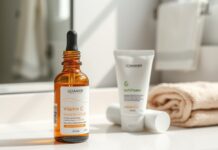
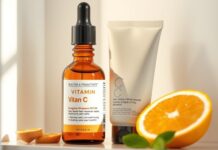







Vitamin C for dark spots may help brighten uneven tone and soften some signs of photoaging, but it is not a quick fix. Results depend on the serum’s form, stability and your skin’s tolerance. The research supports potential benefits, yet does not establish one best formula or guarantee that a store-bought serum will fade every kind of pigmentation.
Vitamin C for dark spots: What the evidence can tell you
Topical vitamin C has antioxidant activity, can affect melanin production and plays a role in collagen formation. Those effects give it a plausible role in addressing discoloration and fine lines linked to sun exposure. Clinical studies have reported improvements, but studies differ in the vitamin C form, formula, delivery method and outcome measured. That makes it hard to predict how much a particular over-the-counter serum will help.
In a 2020 systematic review, Rizwan M. Sanadi and Revati S. Deshmukh examined research on vitamin C and pigmentation in skin and gums. Only seven studies met their criteria: one randomized controlled trial and six experimental studies. The mix of tissues and study methods limits what the review can say about the likely results of a facial serum specifically.
A 2026 systematic review by Tanya Boghosian and colleagues assessed 44 studies of topical, injectable and systemic vitamin C formulations published from 2020 onward. The authors reported benefits across pigmentation and photoaging outcomes, but also noted substantial differences between studies and limited standardized data, particularly across skin phototypes. In other words, the findings are encouraging, but they do not let you compare every serum ingredient or predict results for every complexion.
Choose a formula, not just a percentage
L-ascorbic acid, also called ascorbic acid, is the form with the most clinical validation. It is also unstable and can be difficult to deliver through the skin barrier. Formulas often use a low pH to support its penetration, and stabilizing ingredients may help keep it effective. The exact pH and other ingredients matter; a high percentage alone does not tell you whether the formula is well made or suits your skin.
Other products use vitamin C derivatives, such as ascorbyl glucoside, sodium ascorbyl phosphate or tetrahexyldecyl ascorbate. Some may be more stable or more comfortable for certain users, but clinical evidence is less consistent across derivatives. A 2023 review by Louise Idalgo Vasques, Cristina Wöhlke Vendruscolo and Gislaine Ricci Leonardi found that much of the research on derivatives was laboratory-based, with fewer in-vivo studies and varied methods. There is no clear, evidence-backed winner for all skin types and goals.
Look for a product that names its vitamin C form and gives a concentration, along with packaging that limits exposure to light and air. Dark, tightly closed or air-restrictive packaging is a sensible way to reduce exposure, though packaging alone cannot prove a serum will stay potent. More is not necessarily better: concentrations above 20% have not been shown to add benefit in the research summarized in a review of consumer vitamin C products, and stronger formulas may be more irritating.
How to recognize oxidation and reduce irritation
Vitamin C can break down over time, especially with exposure to air and light. A clear or pale serum that turns noticeably yellow, orange or brown may have oxidized. Color is a warning sign, not a precise test of potency, so also check the product’s expiry date and follow its storage instructions. If the color or smell changes substantially, or it is past its expiry date, replacing it is a reasonable choice.
Stinging, redness or dryness can happen, especially with acidic or higher-strength formulas. If you have sensitive skin, consider a lower-strength product or a derivative-based formula, and introduce it gradually rather than starting several new active products at once. Stop using it if irritation persists or becomes severe; a clinician can help if you are unsure what is causing a reaction.
For more on stability and product design, read this guide to choosing a vitamin C serum that stays effective.
A serum does not replace sunscreen—or oral vitamin C
Topical and oral vitamin C are not interchangeable. Eating a balanced diet helps meet your nutritional needs, but evidence about dietary intake or supplements does not establish that taking vitamin C will fade dark spots in the same way a topical product might. A serum also cannot block ultraviolet rays. Use sunscreen as directed to help protect skin from sun exposure and prevent further darkening; vitamin C is an optional addition, not a substitute.
If pigmentation is persistent, worsening or concerning, a dermatologist or other clinician can assess it and discuss options. Different causes may need different approaches, and a serum’s marketing claims cannot tell you what is behind a particular spot.