

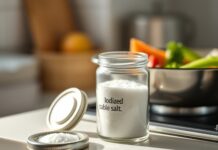















Yes, cooking can reduce how much iodine from iodized table salt remains in a dish, but the loss is not fixed. It varies with the food, cooking method and time. Adding salt near the end may limit its time in the pan, but research does not establish a reliable, meaningful advantage for every recipe. You can use iodized salt in cooking; you do not need to add extra salt to make up for possible losses.
What Cooking Does to Iodine in Iodized Table Salt
A 1999 study by G. Y. Wang, R. H. Zhou, Z. Wang, L. Shi and M. Sun examined iodine in salt during storage and cooking, including how much remained after different foods were cooked. The researchers reported cooking retention ranging from 36.6% to 86.1%. In other words, the iodine remaining varied considerably by food and its water content. That range is not a prediction for your particular meal: the study does not establish one loss percentage for all foods or recipes.
A separate study, titled “Effect of Different Cooking Methods on Iodine Losses,” concluded that losses depended on cooking method and how long the salt was cooked. Its reported conclusion does not provide enough detail to say exactly how much iodine is lost in a typical boiled dish versus a fried one. Taken together, the findings suggest that prolonged cooking can matter, but they do not support a precise rule for every pot or pan.
Does Adding Salt at the End Make a Difference?
Adding salt late reduces the time it is exposed to cooking, so it may help preserve some iodine. But the available study findings do not quantify a dependable benefit from adding it at the end rather than earlier. The size of any difference in an everyday recipe is therefore uncertain.
If a recipe needs salt during cooking for seasoning or technique, there is no evidence here that you should change it solely to protect iodine. You can also season at the table if that suits the dish, but avoid using more salt overall to compensate. The amount of iodine added by salt depends on its fortification level, and cooking losses vary.
Store Salt Away From Heat and Moisture
Storage conditions can affect iodine too. In the 1999 study, iodine loss was greater in salt kept in plastic bags than in glass bottles, and greater in hot, humid conditions than at 20–25°C (68–77°F) with lower humidity. This does not prove that every glass container is better than every modern package, but it supports a simple approach: keep salt sealed in a cool, dry place, away from steam and heat. Follow any storage directions on the package.
Check the Label—and Don’t Use More Salt
Iodine fortification levels and labeling vary by country and product. In the United States, FDA rules require table salt with added iodine to be identified as iodized; that label does not mean every country’s product has the same iodine concentration. In the UK, EU, Australia and elsewhere, check the package rather than assuming that table, sea, kosher or specialty salt is iodized. Salt that is not labeled as iodized should not be counted on as a consistent iodine source.
Most importantly, do not increase your sodium intake to compensate for cooking or storage losses. WHO recommends adults consume less than 2 g of sodium a day—equivalent to less than 5 g (about 1 teaspoon) of salt from all sources. Use iodized salt in place of the salt you would otherwise use, not as an extra addition. If you are concerned about your iodine intake or have a health condition that affects your diet, ask a clinician for advice rather than increasing salt or starting a supplement.