











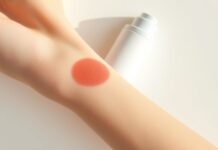









A sunscreen allergy is one possible cause of a rash after applying sun cream, but the product may not be the whole story: sunlight, ordinary irritation or sunburn can also be involved. Where the rash appears and whether it follows sun exposure can help a dermatologist decide what to investigate. A pattern alone cannot confirm the cause.
How A Sunscreen Allergy Differs From Irritation Or Sunburn
Photoallergic contact dermatitis is a delayed allergic reaction that occurs when a substance on the skin is affected by ultraviolet (UV) light. It often appears on sunscreen-covered areas that received sun. The reaction may extend beyond those areas, so its edges do not always match where you applied the product.
With ordinary allergic contact dermatitis, the immune system reacts to an ingredient without needing sunlight. Irritant contact dermatitis is different: a product irritates the skin rather than triggering an allergy. Stinging or burning can occur, though appearance alone is not enough to tell these apart. Sunburn, meanwhile, follows UV exposure and can affect skin whether or not sunscreen was applied. A rash on sun-exposed skin could also have another light-related cause, not a sunscreen reaction.
Note when symptoms start and where they occur. Does the rash affect only exposed skin, or also covered areas where the product was applied? Does it happen with one product, or after time outdoors? These details can help guide an assessment, but they cannot diagnose the cause by themselves.
Which Sunscreen Ingredients May Be Involved?
UV filters are among the ingredients reported in sunscreen-related photoallergy. Examples include benzophenones such as benzophenone-3 (also called oxybenzone), octyl methoxycinnamate (octinoxate) and para-aminobenzoic acid (PABA). Ingredients beyond UV filters may also matter: fragrances, preservatives and other parts of a formula can cause contact allergy or irritation.
A 2009–2020 North American Contact Dermatitis Group analysis examined 454 people referred for photopatch testing because of suspected light sensitivity. About one in six received a final diagnosis of photoallergic contact dermatitis; allergic contact dermatitis and other light-related conditions were also diagnosed. Among the positive photopatch results, sunscreen agents made up 88.2%, with benzophenones accounting for more than half. These findings describe a referred group, not the likelihood that any sunscreen user will develop a reaction.
Ingredient availability differs by market. A 2025 review describes different sunscreen-filter regulatory systems in the United States and the European Union, where sunscreens are regulated as cosmetics and consumers may have access to a broader range of filters. So the same product name—or a product described as “mineral”—does not guarantee an identical formula across countries. Check the ingredient list, and do not assume any category is automatically reaction-free.
What Patch And Photopatch Testing Can Tell You
A dermatologist may recommend patch testing if ordinary contact allergy is suspected. Small amounts of selected substances are applied to the skin, often on the back, and checked for a reaction. For suspected photoallergy, photopatch testing compares duplicate samples: one set is exposed to a controlled amount of UVA light, while the other is kept unexposed. A reaction mainly on the exposed side can support photoallergy; reactions on both sides may point to ordinary contact allergy or another pattern.
Testing can include sunscreen filters, other ingredients and sometimes the products you use. It helps distinguish conditions that can look similar and identify substances to avoid. It does not mean every product containing a suspected ingredient will affect you, and a negative result does not explain every possible rash. The dermatologist interprets the findings alongside your history and examination. Photopatch testing is a specialist procedure, not a home test.
Choosing What To Use Next
If a sunscreen repeatedly causes a rash, bring its packaging or a clear ingredient list to a clinician or dermatologist. Note where you applied it, when symptoms began and whether the area was in sunlight. This can help the clinician decide whether to test the sunscreen itself, individual ingredients or other possible causes.
Once a relevant trigger is identified, you can look for alternatives that do not contain it. The right choice depends on the result and the full formulation; switching filters alone may not be enough if another ingredient is responsible. While you are working out the cause, clothing and shade can provide additional sun protection. Sunscreen reactions can be difficult to sort out, so seek medical advice for a persistent, severe or recurring rash, or if you are unsure whether the problem is light-related.