

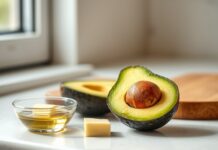

















For avocado and cholesterol, the most useful distinction is whether avocado replaces another food or simply gets added. Randomized trials suggest that eating avocado may modestly lower LDL cholesterol, but findings are mixed and the benefit is not firmly established. The clearest dietary rationale is to swap it for a food high in saturated fat, rather than assume that adding avocado by itself will lower your LDL.
What Trials Say About Avocado And Cholesterol
A 2022 systematic review and meta-analysis by Genevieve James-Martin and colleagues pooled results from nine randomized trials involving 503 adults. Across all participants, avocado diets did not significantly change LDL compared with control diets. In a subgroup of people with high cholesterol, LDL was lower by about 9.4 mg/dL (0.24 mmol/L). The researchers rated confidence in this subgroup finding as low to very low, so it is a promising signal, not a dependable prediction of what will happen to any one person.
A 2025 meta-analysis of 10 randomized trials found a smaller average LDL reduction of about 3.75 mg/dL (0.10 mmol/L). It found no significant changes in total cholesterol, HDL or triglycerides. Taken together, the reviews do not give a single consistent estimate: results differ across analyses, and the average changes reported are modest. Neither review establishes that avocado prevents heart attacks or strokes.
Why Replacing Food Matters More Than Adding It
Avocado contains mostly unsaturated fat, along with fibre in the whole fruit. Replacing some saturated fat with unsaturated fat fits the dietary approach described in US heart-health guidance. But a food’s effect depends partly on what it takes the place of. If avocado replaces butter or another saturated-fat-rich spread, the swap changes the types of fat in your diet. If you add it on top of your usual meals, you have not made that substitution.
Many avocado trials changed the diet rather than simply asking people to add fruit. For example, a 12-week randomized trial at the Illinois Institute of Technology in Chicago enrolled 93 adults with overweight or obesity and insulin resistance. Participants exchanged avocado or an energy-matched control food for carbohydrate foods. It did not test replacing butter or other foods high in saturated fat, so it cannot answer that specific question. It does illustrate why trial results from a planned food exchange should not be treated as proof that adding avocado has the same effect.
Separate from trials, a long-term study of US nurses and health professionals found that replacing foods such as butter, cheese or processed meat with avocado was associated with lower cardiovascular disease risk. Because participants were not randomly assigned to make those swaps, this does not prove that avocado caused the difference. It also measured disease risk, not the effect of a swap on LDL in a clinical trial.
Portion Size And The Difference Between Fruit And Oil
Amounts in trials varied, with interventions ranging from about half an avocado to two per day. One commonly used reference serving is 50 g (about one-third of a medium Hass avocado), which provides roughly 80 calories. That is a useful size for understanding portions, not a proven LDL-lowering dose. If you are using avocado instead of another food, consider the amount you are replacing as well as the avocado portion; simply piling it onto meals changes the overall energy intake.
Whole avocado and avocado oil should not be treated as interchangeable evidence. The whole fruit contains fibre, while oil does not retain the fruit’s fibre and structure. Although both can supply unsaturated fat, the randomized-trial reviews do not report a separate, reliable LDL estimate for avocado oil. Results from whole-avocado diets therefore cannot establish that avocado oil lowers LDL by the same amount. If you choose oil, think of it as a cooking fat that may replace a more saturated fat—not as a proven cholesterol treatment.
What You Can Reasonably Take Away
Replacing a saturated-fat-rich food with a modest portion of whole avocado is a reasonable way to change the fat mix in a meal. Trials suggest the LDL effect may be small, and they do not show a guaranteed response; evidence is especially uncertain for people without high cholesterol and for avocado oil specifically. If you have high LDL or take cholesterol-lowering medication, discuss your overall plan and test results with a clinician rather than relying on avocado as a substitute for prescribed care.