











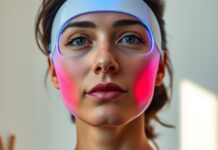






If you’re considering an LED mask, the short answer is that blue or combined blue-red light may improve mild inflammatory acne, but results are not guaranteed and are not interchangeable across devices. The research on led face mask side effects is also limited: some trials reported mild skin irritation, while they do not establish the eye safety or photosensitivity risk of every mask on sale.
What LED Masks May Do For Acne
Blue light can activate compounds produced by acne-associated bacteria in skin follicles; red light penetrates farther and may have anti-inflammatory effects. That gives a plausible reason to study the two wavelengths, but a proposed mechanism is not proof that every consumer device will clear acne.
The clearest home-use example is a double-blind, sham-controlled trial conducted in South Korea. H. H. Kwon and colleagues studied 35 people with mild-to-moderate acne. Participants assigned to the active device treated their forehead and cheeks with 420-nanometre blue light and 660-nanometre red light for 2.5 minutes, twice daily, for four weeks. At the 12-week visit, inflammatory lesions had fallen by 77% and noninflammatory lesions by 54% in the treatment group; the sham group had no significant change. No severe adverse reactions were reported.
Those results are encouraging, but they come from a small trial of one device and one exact schedule. They do not show that a different mask, treatment duration, or routine will produce the same change. The trial also followed participants only to 12 weeks, so it cannot establish how long any improvement lasts.
Why Results Depend On The Device And Schedule
LED treatments vary in wavelength, light output, energy delivered, treatment time, and how often you use them. These details matter: a mask that emits different wavelengths or delivers a different dose is not necessarily equivalent to the device tested in a trial. Follow the instructions for the specific device; don’t assume that longer or more frequent sessions will work better.
Evidence across trials is mixed. A 2019 systematic review and meta-analysis by Anna Mae Scott and colleagues included 14 randomized trials with 698 participants. Most trials were small, lasted under 12 weeks, and had a high risk of bias. Pooled differences in inflammatory and noninflammatory lesion counts were not statistically significant. That does not prove blue light cannot help; it means the combined trial results did not establish a reliable advantage over comparison treatments.
A 2022 randomized study of 28 people compared red light with blue light and followed participants for two weeks after treatment. Average improvements did not differ significantly between groups. Taken together, the findings support cautious interest in light therapy, not a promise of a particular percentage improvement. Benefits also appear more consistent for inflamed spots than for clogged pores alone.
LED Face Mask Side Effects And Eye Safety
Reported effects in acne trials included dryness, redness, and peeling. The small red-versus-blue comparison observed treatment-related adverse reactions more distinctly in the blue-light group, but its size and short follow-up do not settle how often problems occur with masks generally. The Korean combination-light trial reported no severe reactions.
Eye safety and photosensitivity need separate consideration. The acne trials described here do not establish that every mask is safe for the eyes or for people with photosensitive skin conditions or medication-related sensitivity. Check the device’s eye-protection instructions and warnings, and ask a clinician or pharmacist before use if you have an eye condition, a known photosensitivity disorder, or take medication that may increase light sensitivity. Stop using the device and seek medical advice if you develop a concerning reaction.
What FDA Clearance Does—and Doesn’t—Mean
In the United States, FDA clearance applies to a particular device and intended use; it is not a blanket endorsement of LED masks as a category, proof that one product is better than another, or evidence that a mask replaces standard acne care. Check what condition the manufacturer says its device is cleared for, and distinguish that claim from marketing language. Regulatory pathways and terminology differ by country, so U.S. clearance does not automatically establish the same status elsewhere.
LED therapy is best viewed as a possible add-on, not a proven substitute for established acne treatments. The research does not show that masks consistently outperform standard topical options, and the systematic review identified important limits in the trials. If acne is persistent, painful, scarring, or not improving, speak with a clinician about treatment options rather than relying on a mask alone.