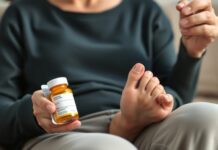
If you’re planning h pylori retesting after treatment, timing and medication use can affect whether the result is trustworthy. Proton pump inhibitors (PPIs), antibiotics and bismuth can suppress H. pylori enough to produce a false-negative result on tests for active infection. In general, stop PPIs for two weeks and antibiotics and bismuth for four weeks before testing—but check the instructions from your clinician or laboratory before changing any medicine.
Why Some Medicines Can Hide H. pylori
A urea breath test or stool antigen test looks for signs of an active infection. PPIs reduce the bacteria’s activity, while antibiotics and bismuth can suppress or reduce the bacteria themselves. If you take these medicines too close to testing, there may be too little detectable activity or bacterial material for the test to pick up.
Common preparation guidance is to leave at least two weeks between your last PPI dose and a breath or stool test, and at least four weeks after antibiotics or bismuth. These are typical minimum intervals, not a reason to stop prescribed treatment on your own. If you need ongoing acid-reducing medicine, ask the clinician who ordered the test how to manage the gap safely and whether a different test date is appropriate.
The effect is not just theoretical. In a prospective study at 10 facilities in Japan, conducted from December 2020 to July 2022, researchers compared two stool antigen assays in patients already diagnosed with H. pylori who had not previously been treated. The newer bioluminescent assay detected infection in 65.9% of PPI users, compared with 87.1% of those not taking a PPI. The conventional assay’s sensitivity was also lower in PPI users: 54.1%, versus 72.4%. Even the newer test performed less well during PPI use. The study involved specific assays and confirmed-infection patients in Japan; its figures are not a universal accuracy estimate for every test or population.
H. pylori Retesting After Treatment: Timing And Test Choice
A test of cure checks whether treatment cleared the infection; it is different from checking whether symptoms have improved. Symptoms alone cannot confirm eradication. A urea breath test or stool antigen test can detect active infection and is generally used for follow-up. After treatment, wait at least four weeks after finishing antibiotics, then allow the medication washout—typically two weeks off PPIs and four weeks off bismuth—before taking the test. Some local pathways schedule follow-up later, such as at eight weeks, so follow the timing used by your clinician or laboratory.
Recommendations about whether everyone needs a test of cure vary by setting. The Houston Consensus Conference, a US expert panel, recommended confirming eradication after treatment. By contrast, NHS Borders guidance says routine confirmation may not be needed for some people who are symptom-free, while advising later testing in particular situations. That is a local pathway, not a rule for the whole UK. Ask whether your local guidance recommends follow-up in your case; confirmation is especially important when your clinician advises it because of your medical history or treatment circumstances.
What A Blood Test Can—and Can’t—Tell You
H. pylori blood tests detect antibodies, not the bacteria itself. Antibodies can remain in your blood for months or years after successful treatment, so a positive result cannot reliably show that infection is still active and should not be used to confirm a cure. In areas where infection is less common, a positive antibody result may also be more likely to be false positive. This is why a blood test’s apparent accuracy is not the only question: it matters whether you need to know about current infection or past exposure.
If a blood test is positive, ask your clinician whether an active-infection test is needed. For follow-up after treatment, a breath or stool test is generally more informative than repeating antibody testing.
Before You Book Or Give A Sample
- Tell the clinician or testing service about recent PPIs, antibiotics and bismuth, including combination medicines that contain bismuth.
- Check the laboratory’s specific preparation and sample instructions; test methods and local pathways can differ.
- If a result is negative but you tested too soon after these medicines, ask whether repeating the test after the recommended washout is appropriate.
Do not stop essential medication without medical advice. If your result is negative but your clinician still suspects infection, or you have ongoing concerns after treatment, discuss what follow-up makes sense with them.