






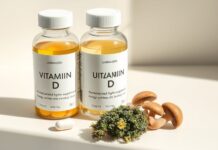














When comparing vitamin d2 vs d3 supplements, the short answer is that D3 tends to raise blood 25-hydroxyvitamin D more than D2, but it isn’t a universal or guaranteed advantage. Both forms can raise vitamin D levels. Your choice may come down to the size of the difference, your dietary preferences and the dose recommended for you.
Vitamin D2 Vs D3: What The Evidence Says
Vitamin D2, or ergocalciferol, is commonly made from fungi such as yeast and mushrooms. Vitamin D3, or cholecalciferol, is the form your skin makes in response to UVB light and is also found in some animal-derived sources. Both are converted in the body, and a blood test for total 25-hydroxyvitamin D (25(OH)D) is used to assess vitamin D status.
A 2021 systematic review and meta-analysis by Rakesh Balachandar, Raghu Pullakhandam, Bharati Kulkarni and Harshpal Singh Sachdev combined results from 24 controlled studies involving 1,277 apparently healthy participants. Across those studies, D3 raised total 25(OH)D by an average of 15.69 nmol/L (about 6.3 ng/mL) more than D2. The researchers also found that D3 was more effective overall at reducing parathyroid hormone, a marker involved in calcium regulation.
That average does not predict how much either supplement will change your own test result. The review combined studies with different doses and schedules, and the researchers found that the difference between forms was smaller at lower daily doses. A separate trial comparing 1,000 IU (25 micrograms) of each form daily found D2 as effective as D3 for maintaining 25(OH)D. So, D3’s overall edge doesn’t mean D2 fails to work.
Does The Difference Matter In Practice?
For many people choosing a routine supplement, the evidence gives D3 a modest practical advantage: it is more likely to raise total 25(OH)D by a greater amount under the studied conditions. But blood levels are a measure of vitamin D status, not proof that one form produces better health outcomes for every person. The comparisons summarized in the 2021 review do not establish that choosing D3 rather than D2 leads to better results for symptoms, fractures or other long-term outcomes.
D2 can still be a reasonable option, including when it better fits your dietary needs or the product recommended to you. If you have a diagnosed deficiency or take a prescribed vitamin D treatment, don’t switch forms or change the dose based on this comparison alone. Ask your clinician or pharmacist what fits your situation; the right dose and follow-up depend on individual circumstances and local guidance.
How To Find Vegan D3 Made From Lichen
Some vitamin D3 is made from lichen, a non-animal source. Look for wording such as “lichen-derived D3,” “vegan vitamin D3” or “plant-based D3” on the label or product details. “Vitamin D3” or “cholecalciferol” alone identifies the form, not its source. If the label is unclear, ask the manufacturer to confirm that the D3 comes from lichen.
Check the rest of the product too: a vegan D3 ingredient does not automatically make the whole capsule vegan. Look for gelatin in the capsule shell and review other listed ingredients. D2 is often made from fungi or yeast, but the same label check applies if you want to ensure the complete product suits your diet.
Choose The Product That Fits
Compare the amount per serving, the form you prefer and whether the product meets your dietary requirements. Labels may list vitamin D in micrograms or international units (IU): 1 microgram equals 40 IU. Make sure you are comparing the same serving size, and follow the dose advised for you or the relevant guidance where you live. A product’s form matters, but it is only one part of choosing a supplement.