





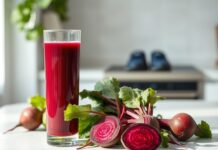












Beet juice athletic performance research points to a possible, usually modest benefit for some endurance measures—not a dependable boost for every workout. Dietary nitrate from beetroot can support the body’s nitric oxide pathway, which may help muscles use oxygen more efficiently. Whether that translates into a faster race or more power depends on the exercise, the person and the product’s actual nitrate dose.
What Beet Juice May Do For Endurance
A 2021 systematic review and meta-analysis by Chloe Gao and colleagues pooled 73 studies involving 1,061 healthy adults who did endurance activities. Nitrate supplementation improved some measures, including power output, distance and time to exhaustion. But it did not significantly improve time-trial performance or perceived exertion. That distinction matters: being able to continue longer in a controlled test does not necessarily mean you will finish a race faster.
A broader 2025 umbrella review by Eric Tsz-Chun Poon and colleagues brought together 20 systematic reviews and meta-analyses, representing 180 studies and 2,672 participants. It found improvements in time-to-exhaustion tasks, total distance, muscular endurance and some power measures, but not across all performance outcomes. The authors also rated the quality of most included reviews as low or critically low. Taken together, the findings suggest a potential edge in selected tasks, not a predictable result for everyone.
Less-trained people may be more likely than highly trained athletes to see an endurance benefit, but training status does not guarantee a response. A 2025 umbrella review by Chen Tian and colleagues found small or negligible average effects and reported different patterns in athletes and non-athletes. Those subgroup findings are not a reliable way to predict what one person will experience.
High-Intensity Results Are Less Clear
Beetroot juice is not well supported as a way to raise sprint or interval power. In a 2021 meta-analysis, Tak Hiong Wong, Alexiaa Sim and Stephen F. Burns examined 17 studies of high-intensity interval and sprint-interval training. They found no significant improvement in either mean or peak power output.
A separate 2022 review by the same researchers looked at 24 studies of high-intensity endurance time trials lasting 5–30 minutes. The overall effect was trivial and borderline; the acute-dose subgroup did not show a significant effect, while the chronic-dose result was small and borderline. This is not necessarily at odds with improved time-to-exhaustion tests: those tests measure how long someone can continue under set conditions, while a time trial measures performance against a set distance or workload. For a race or interval session, the evidence for a noticeable improvement is therefore uncertain.
Beet Juice Athletic Performance: Dose And Timing
Research protocols commonly use about 5–16.8 millimoles of nitrate (roughly 310–1,040 mg) taken 2–3 hours before exercise. Some studies instead give nitrate daily for several days. These are ranges used in research, not a proven ideal dose for every athlete. The 2025 umbrella review by Poon and colleagues found stronger time-to-exhaustion results in studies using at least 6 mmol per day for more than three days, but that does not establish the best plan for a particular event or person.
If you choose to try a product, test it during training rather than on race day. Check the label for the amount of nitrate, not just the serving size or the words “beetroot” and “pre-workout.” Some research has found beetroot juice’s nitrate and other plant compounds may matter, so a powder scoop cannot automatically be treated as equivalent to a juice serving.
Why Juice And Powder Labels Matter
Nitrate levels vary in beetroot itself: one review reported a wide range in fresh beetroot content. That means the volume of juice—or the weight of a powder serving—does not tell you the nitrate dose unless the product provides that information. Products can differ, so compare stated nitrate amounts rather than assuming all beetroot juices or powders are interchangeable. Avoid antibacterial mouthwash around the dose if you are trying to support nitrate conversion: oral bacteria are part of the process, and mouthwash can interfere with it.
Safety And When To Check With A Clinician
Nitrate can lower blood pressure, which is relevant if your blood pressure is already low or you take medicines that lower it. Check with a clinician or pharmacist before using a concentrated beetroot product in those situations, especially if you have a health condition or take medicines affecting blood pressure or blood-vessel function. Beetroot products should not replace prescribed treatment or medical advice. For more on day-to-day blood pressure care, see this guide to managing high blood pressure.
For exercise, beetroot juice is best viewed as an optional supplement with a possible small benefit for some endurance tasks. It cannot replace consistent training, and current findings do not support expecting a reliable improvement in sprint power or race times.