

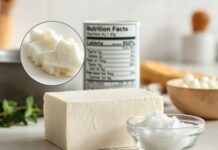



















Calcium in tofu depends largely on the coagulant used to set the soy milk. Tofu made with calcium sulfate (also spelled calcium sulphate) can contain much more calcium than tofu set with nigari, which is mainly magnesium chloride. Since brands use different recipes and serving sizes, check the nutrition panel rather than assuming all tofu provides the same amount.
What Changes the Calcium in Tofu?
Coagulants make soy proteins come together into curds. Calcium sulfate supplies calcium as it helps the curds form, so some calcium remains in the finished tofu. Magnesium chloride supplies magnesium instead; tofu made with it is not automatically a meaningful calcium source. Nigari is traditionally a magnesium salt mixture, commonly containing magnesium chloride and magnesium sulfate.
The coagulant is a useful clue, not a precise nutrition calculation. The amount used, the production method and the tofu’s moisture and firmness can all affect the final calcium amount. Some products also use more than one coagulant. For example, a U.S. Department of Agriculture FoodData Central legacy entry for soft tofu made with both calcium sulfate and nigari lists 111 mg of calcium per 100 g (about 3.5 oz). That is a specific food entry, not a prediction for every mixed-coagulant tofu.
Why Calcium-Sulfate Tofu Can Be Much Higher
Reference values show how wide the difference can be. A U.S. National Institutes of Health table lists regular tofu made with calcium sulfate at 434 mg per half cup, and firm calcium-sulfate tofu at 860 mg per half cup. These are reference figures for particular entries, not guarantees about what you will find in a packet. A brand’s label is the better guide to that product.
The contrast makes sense: calcium sulfate adds calcium during setting, while magnesium chloride does not. But the numbers should not be treated as a simple ranking of every firm tofu over every soft one. Firmness terms are not used consistently between manufacturers, and a half-cup portion may not weigh the same from one product to another.
How to Compare a Tofu Nutrition Label
- Check the ingredient list. Look for “calcium sulfate” or “calcium sulphate” if you want a likely calcium-rich option. “Magnesium chloride” or “nigari” points to a magnesium-based coagulant. Ingredient lists help explain a label, but they do not replace the calcium amount.
- Compare like with like. Nutrition panels may give calcium per serving, per 100 g, or both. Comparing the per-100-g amount is useful when serving sizes differ; then check the stated serving to see how much you are likely to eat. In U.S. measures, 100 g is about 3.5 oz.
- Use the number, not the firmness name. “Firm” and “soft” do not tell you the calcium content by themselves. Read the calcium value in milligrams and check whether it is listed for the drained product or another stated portion.
- Pay attention to regional label formats. Labels may show calcium in milligrams, as a percentage of a reference daily value, or both. For comparing products across countries, the milligram amount per 100 g is usually the clearest common measure. Daily reference values and label rules can differ by region.
If the ingredient list names calcium sulfate but the label gives little or no calcium, use the label’s stated amount for your comparison rather than estimating from the coagulant. The final amount depends on the product’s recipe and processing.
Choosing Tofu as a Calcium Source
If calcium is a priority, start by checking the nutrition panel and favor a product that lists a substantial amount per serving you actually eat. Calcium-sulfate-set tofu is often the stronger candidate, but the brand’s declared value is what matters. If you are comparing tofu with other non-dairy foods, our guide to calcium-fortified plant milks explains why checking the label matters there, too.
In short: the coagulant explains why tofu calcium varies, while the label tells you what is in the product you are buying. Compare the calcium amount using the same weight or serving basis, and treat general food tables as examples rather than brand-specific promises.