












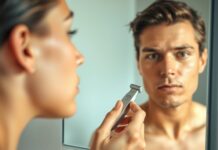








If you’re wondering about waxing after accutane, the cautious answer is to avoid facial waxing while taking oral isotretinoin and ask your prescriber when it may be appropriate to resume. Topical retinoids such as tretinoin are a different situation: they can leave skin irritated, but there is no established universal waiting period for facial waxing. In either case, waxing can pull at the skin as well as remove hair, raising the risk of a raw patch, skin lifting or injury.
Why Retinoids Can Make Waxing Riskier
Wax grips hairs and is pulled away from the skin. If the surface is already irritated or vulnerable, that tug may remove some of the outer skin along with the hair. The result can be soreness and rawness, or a more noticeable injury.
Tretinoin and other topical retinoids affect how skin cells grow and shed. Tretinoin can also cause localized irritation. That does not mean everyone using a topical retinoid will be injured by waxing; it does mean you should not treat calm-looking skin as a guarantee that waxing is safe. Redness, peeling, tenderness or a recent increase in your product’s strength are reasons to postpone and check with the prescriber.
Oral isotretinoin (known by brand names including Accutane in the United States and Roaccutane in some countries) is not the same as a topical retinoid. It commonly causes dry skin, and product warnings have specifically advised against waxing during treatment and for a period afterward.
Waxing After Accutane: What The Six-Month Advice Means
US Food and Drug Administration advice and isotretinoin patient information have traditionally told patients to avoid waxing while taking the medicine and for at least six months after stopping. That is the clearest formal waiting-period guidance in the material here, but it is not the last word on every skin procedure.
In 2017, Venkataram Mysore and colleagues published guidelines for the Association of Cutaneous Surgeons (India). Their task force reviewed earlier reports and other guidance, and argued that the longstanding six-month delay for a broad range of cosmetic procedures lacked adequate evidence. The paper describes old reports of scarring after procedures, but notes that they were few and often involved more aggressive or outdated techniques. The task force considered several procedures, including laser hair removal, safe during or soon after isotretinoin use.
That conclusion should not be read as proof that waxing is safe on isotretinoin: the listed procedures deemed safe did not include waxing. The paper challenges a blanket delay for all procedures; it does not establish a new, waxing-specific waiting period. The six-month warning remains part of formal patient guidance in some places, so check the current instructions for your medicine and discuss your circumstances with your prescriber. Advice may differ by country and product information.
What About Waxing While Using Tretinoin?
For topical tretinoin, there is no matching, universally established six-month rule in the guidance described above. Nor does it give a reliable number of days to stop before waxing or to wait after the last application. A pause should not be assumed to make waxing safe, especially if your skin is still dry, peeling or sensitive.
Tell your clinician the exact product, strength and how often you use it, and describe where you want waxed. Ask whether to avoid waxing altogether while treating that area and, if not, what timing they recommend for you. Don’t stop a prescribed treatment without checking with the person who manages it.
Hair-Removal Options To Discuss
Trimming or careful shaving avoids pulling wax from the skin’s surface, so it may be a lower-trauma option while your skin is sensitive. These methods can still irritate or nick skin, so use a gentle approach and avoid areas that are already sore or broken.
Laser hair removal may be worth asking a dermatologist about if you take isotretinoin. The 2017 Indian task force considered it safe during or soon after treatment, but recommendations and individual suitability can vary. That finding does not mean every laser treatment or provider will take the same approach. Ask the clinician who knows your medication and skin whether it is appropriate for you.
If you have already waxed and your skin has lifted or become raw, avoid waxing the area again and contact a clinician for advice, particularly if the injury is extensive or not healing. Before your next appointment, tell your waxing professional about your medication—but check with your prescriber rather than relying on a salon’s timing advice.