

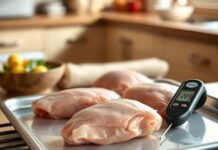


















Yes, you can cook chicken from frozen. Use a method that heats it promptly, allow extra time, and check the chicken internal temperature with a food thermometer rather than relying on the clock or the meat’s appearance. An oven is a dependable choice; a covered pan or air fryer can work for suitable cuts when you follow the recipe or appliance instructions.
Methods That Work—and One to Avoid
For raw frozen pieces, bake them in a preheated oven, arranged in a single layer where possible. On the hob, use a covered pan with liquid to simmer or braise the chicken until it is cooked through. This is more reliable than quickly browning a frozen piece in a shallow pan, where the outside may cook well before the centre. For an air fryer, follow instructions that specifically suit the product and its frozen state.
Do not put frozen chicken in a slow cooker. It heats food gradually, so the chicken may spend too long warming through before it reaches a safe cooking temperature. Slow cookers are useful for keeping already-cooked food hot, but that does not make them suitable for starting with frozen raw poultry. If a recipe calls for thawed chicken in a slow cooker, thaw it safely first.
How Much Longer Does Frozen Chicken Take?
As a general guide, cooking chicken from frozen can take about 50% longer than cooking the same cut from thawed. Treat that as a planning estimate, not a guaranteed time: thickness, whether pieces are separated, oven or hob performance, and the cooking method all affect the result. A frozen breast will not take the same time as small pieces or a whole bird.
Start checking before the recipe’s extended time is up, then keep cooking and check again if needed. If pieces are frozen together in a solid block, they may cook unevenly; use the package directions or thaw them safely before separating and cooking. Never count on a browned surface, clear juices, or a set timer alone to confirm doneness.
Check Chicken Internal Temperature With a Thermometer
Insert a food thermometer into the thickest part of each piece, avoiding bone. For a whole bird, check the thickest parts of the breast and the inner thigh. If you are cooking several pieces, check more than one, since they may not finish at the same time. The reading should meet the guidance for your location:
- United States: 165°F (about 74°C) for poultry.
- United Kingdom: 70°C for 2 minutes, or an official equivalent time-and-temperature combination.
- European Union: There is not one household cooking temperature used uniformly across all member countries. National advice may give a temperature with a holding time or an equivalent combination; follow your country’s food-safety guidance.
- Australia: 75°C is a commonly used safe internal temperature for poultry.
These figures are close, but they are not all expressed in the same way: some guidance pairs a temperature with a required holding time. Use the recommendation for where you live rather than assuming the numbers are interchangeable. When cooking chicken for someone at higher risk from foodborne illness, take extra care to follow local food-safety advice.
Let the Package Guide the Clock
Frozen breaded chicken, nuggets, and other prepared products may have specific oven or air-fryer directions. Follow the package instructions, and check the centre with a thermometer if the product is raw or the label calls for it. For plain chicken, a recipe’s time for thawed meat is only a starting point; the thermometer reading is what tells you it is done.
If you have time to thaw first, do so in the refrigerator rather than leaving chicken on the counter. For another example of why a thermometer matters for meat, see this guide to burger internal temperature.