












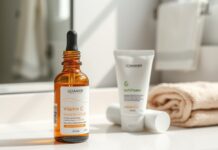
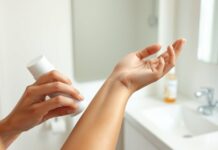





If you’re wondering, “are self tanners safe,” the answer depends partly on how you apply them. DHA lotions and creams are intended for external use on skin, where they darken the surface. Spray tans can make it harder to keep DHA out of your lungs, eyes, nose, mouth and other mucous membranes—exposure routes for which safety is not established. And a cosmetic tan is not a substitute for sunscreen.
Are Self Tanners Safe? Lotion And Spray Are Not The Same
Dihydroxyacetone (DHA), the active ingredient in many self-tanners, reacts with amino acids in the outer skin to create a temporary brown color. The effect usually fades over several days as surface skin cells shed. It is a cosmetic color change, not the UV-driven process that produces a suntan.
For a lotion or cream, the intended use is easier to keep to external skin: you can apply it without creating a cloud of product. The US Food and Drug Administration (FDA) permits DHA as a color additive for external application, but not on the lips, mucous membranes or in the eye area. The agency says safety data have not been submitted for these routes, including inhalation. That means the risk is unknown; it does not establish that harm will occur every time there is contact.
US rules also distinguish retail lotions from all-over misting in commercial spray-tan booths. The FDA says booth use has not been approved because the required safety data for that use have not been submitted. This is a reason to take spray precautions seriously, not proof that every spray session causes injury. Salon oversight may also involve state or local authorities.
Rules and assessments differ by region. In the European Union, the Scientific Committee on Consumer Safety concluded in a 2010 assessment that DHA in skin formulations at concentrations up to 10% would not pose a health risk to consumers. That assessment concerns skin formulations; it should not be read as a safety finding for inhaling spray or getting product in the eyes or mouth.
What Research Can And Cannot Tell You
A 2023 review by Shayan Owji, Fayven Teklehaimanot, Jalal Maghfour and Henry W. Lim examined research on topical DHA. The authors found reports of irritant and allergic contact dermatitis, while noting that other side effects in humans had not been observed in the literature they reviewed. They also concluded that more research is needed on the concentrations and application frequencies consumers typically encounter.
Laboratory findings need careful interpretation: cell studies suggest DHA can affect cells under some conditions, but they do not show that ordinary use of a lotion causes the same effects in people. The review found that concentrations much higher than those in self-tanning products were needed to cause significant cell toxicity in vitro. Current research therefore does not settle every question about repeated use or spray exposure, but it also does not justify treating cell experiments as proof of harm from routine topical application.
For a closer look at precautions, read our guide to spray-tan safety and the limits of DHA safety.
How To Reduce Exposure
- Choose a lotion or cream if you want to avoid creating an airborne mist. Follow the label and keep product away from your eyes, nostrils, lips and mouth.
- For a spray tan, ask about safeguards before booking. Find out how the salon protects your eyes and mucous membranes and prevents you from inhaling the spray. If it cannot explain how it does this, choose another option.
- Do not inhale or swallow the product. Avoid applying it to broken skin, and stop using it if you develop a rash or irritation. If a reaction persists or concerns you, seek advice from a clinician.
These steps reduce avoidable contact; they cannot turn an unapproved exposure route into one with established safety. If you have a history of skin reactions, consider discussing product use with a clinician before applying it.
A Cosmetic Tan Does Not Replace Sunscreen
The color from DHA provides little to no reliable protection from ultraviolet (UV) radiation, according to the 2023 review. A darker-looking tan does not tell you that your skin is protected. Most self-tanners do not contain sunscreen; only products with sunscreen ingredients and a stated sun protection factor (SPF) may offer protection, and you should follow their label directions.
Use a separate sunscreen or a self-tanner clearly labeled with SPF, applying it to exposed skin as directed before going outdoors. In the US, FDA guidance says to apply an even coat at least 30 minutes before going outside. A self-tan can change your skin’s appearance, but it cannot reliably help prevent sunburn or UV damage.