



















If you may have eaten a wild mushroom you can’t confidently identify, contact a poison centre or local urgent health service now—even if you feel fine. Mushroom poison exposure can cause symptoms quickly or after a delay, and feeling well at first does not rule out a dangerous toxin. If someone is seriously unwell, call your local emergency number.
What To Do After Possible Mushroom Poison Exposure
Call your regional poison centre or poison information service as soon as possible and tell them what happened. If you can’t reach one promptly, contact an urgent medical service. Poison-response pathways differ by country and region, so use the official service for where you are rather than relying on a number from another country. In Victoria, Australia, the Victorian Poisons Centre advises calling 13 11 26; call 000 for an emergency.
- Share when the mushroom was eaten, how much may have been eaten, how it was prepared, and who ate it. Mention any symptoms and when they began.
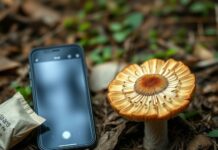
- If safely available, keep a leftover mushroom or uncooked sample and take clear photos. A poison specialist may ask for them to help assess the exposure. Don’t delay calling to find or collect a sample.
- Don’t eat any more from the same collection or rely on a visual guess, a home test, or an online identification to decide it is safe.
Seek emergency help for serious symptoms such as severe vomiting or diarrhoea, confusion, breathing problems, seizures, or collapse. If symptoms develop after you have already contacted a poison service, call back or seek urgent care as directed.
Why Feeling Well At First Can Be Misleading
Different mushroom toxins cause different effects. Some lead to early stomach upset; others can damage organs after a symptom-free interval. In Victoria, the state health department warns that death cap mushroom symptoms may begin 6–24 hours after eating. That timing is specific to a dangerous species found in that region, not a safe waiting period for other mushrooms or places.
A CDC report published in May 2026 described 39 suspected amatoxin poisonings after people ate foraged mushrooms in Northern California between November 2025 and March 2026. The California Poison Control System and the California Department of Public Health coordinated the response. Thirty-two patients recovered, three received liver transplants, and four died. This case series shows why delayed illness can be serious; it cannot predict what will happen after any one exposure.
Timing is not uniform across cases. In a retrospective study, Şevki Hakan Eren and colleagues examined 294 patients admitted to Cumhuriyet University Hospital in Sivas, Turkey, from 2000 to 2007. Six had delayed symptoms, which the researchers defined as starting 6 hours to 20 days after ingestion. The mushroom toxins were not chemically analyzed, so this hospital series cannot establish a safe time to wait for symptoms.
Cooking Does Not Make An Unknown Mushroom Safe
Cooking, drying, soaking, or peeling does not neutralize every mushroom toxin. Victoria’s health guidance specifically warns that these methods do not make death caps edible, and a CDC report on Amanita muscaria notes that its toxins might not be deactivated by cooking. Some other mushrooms have different toxins and preparation effects, but that does not make kitchen preparation a reliable safety test for an unidentified mushroom. For more on this distinction, read our guide to why cooking won’t make a wild mushroom safe.
Local Species And Advice Matter
Wild mushroom species vary by location, and lookalikes can be difficult to distinguish. A species or identification guide from another country may not apply where you found the mushroom. The CDC’s Northern California report also described people who had previously foraged similar-looking mushrooms in other countries; familiarity with one region’s fungi did not establish that a local mushroom was safe.
Poison services can help assess a suspected exposure and advise whether medical evaluation is needed. Call before symptoms appear. If you or someone with you becomes seriously ill, contact emergency services immediately. This article cannot identify a mushroom or assess an individual exposure; follow advice from a poison specialist or clinician.