











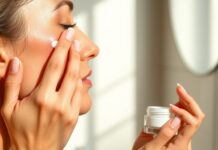







If you’re asking, “does collagen cream work,” the clearest answer is: it can moisturize and soften the look of dry skin, but a cream containing collagen has not been shown to reliably rebuild the collagen network deep in your skin. Hydrolyzed collagen and peptides are smaller than intact collagen, but that alone does not prove they reach the dermis or make your skin produce more collagen.
Does Collagen Cream Work? Start With The Skin Barrier
Most of the collagen that gives skin strength and elasticity sits in the dermis, beneath the outermost barrier, the stratum corneum. Intact collagen is a large protein. A 2024 review by Barbara Jadach, Zofia Mielcarek and Tomasz Osmałek explains that it cannot cross the epidermal barrier in its whole form. On the skin’s surface, collagen can help retain moisture and form a conditioning film. That may leave skin feeling smoother and make fine lines caused by dryness look less noticeable, without replacing collagen in the dermis.
This distinction matters when you judge a wrinkle claim. A softer, more hydrated surface can look temporarily smoother; that is a cosmetic effect, not proof that the cream has rebuilt skin structure. A moisturizer can be worthwhile for comfort and appearance even if it does not stimulate new collagen.
Do Hydrolyzed Collagen And Peptides Penetrate Better?
Hydrolyzed collagen is collagen broken into smaller fragments. Cosmetic labels may also use the term collagen peptides; these products can contain shorter fragments, though names alone do not tell you the size, formulation or performance of the ingredient. Smaller fragments may have a better chance of moving into the outer layers than intact collagen. The skin’s barrier still limits how much gets through, and penetration can depend on the formulation.
Even if a fragment enters the skin, that does not establish that it reaches dermal cells intact, in a useful amount, or signals them to make new collagen. Research on peptides’ possible biological activity is not the same as evidence that a particular cream rebuilds collagen in people. The key question is whether a finished topical product has been tested in well-designed human studies—not simply whether it contains a smaller ingredient.
Reviews have described possible improvements in hydration, elasticity and wrinkle measures with collagen products. But findings from oral supplements and topical creams should not be treated as interchangeable. Hend Al-Atif’s 2022 review assessed 12 original studies published in English from 2010 to 2020, and discussed both oral and topical collagen. Its broad conclusion does not establish how much benefit comes from topical collagen specifically, or whether any observed change reflects deeper collagen rebuilding. Results from oral collagen, which is digested and absorbed, cannot prove that a cream has the same effect.
How To Judge Wrinkle Claims
Look for human trials of the exact finished cream, not just laboratory research on an ingredient or studies of an oral supplement. Useful details include how many people took part, how long they used it, whether it was compared with the same moisturizer without collagen, and whether wrinkle changes were measured objectively. A claim about hydration or smoother-looking skin is more modest than a claim that the product increases collagen in the dermis.
For reducing the appearance of photoaging and fine wrinkles, topical retinoids have a stronger research history than collagen creams. They can irritate skin, and retinoids are not appropriate during pregnancy; see this guide to retinoids and pregnancy for more detail. Sun protection is also a sensible way to help limit UV-related skin aging. Neither option guarantees a particular cosmetic result, and what suits you depends on your skin and circumstances. If you’re considering a retinoid and are pregnant, trying to conceive or unsure which product is suitable, ask a clinician.
You do not need to avoid collagen moisturizer if you enjoy how it feels. Think of it as a moisturizer first, and be cautious about paying extra for promises to rebuild skin collagen unless the specific product has convincing clinical testing. If your main goal is smoother-looking skin, compare the product’s tested outcomes with established options and choose based on your priorities, budget and tolerance.